
Places · Street note
Home battery installation in Norwich
Updated
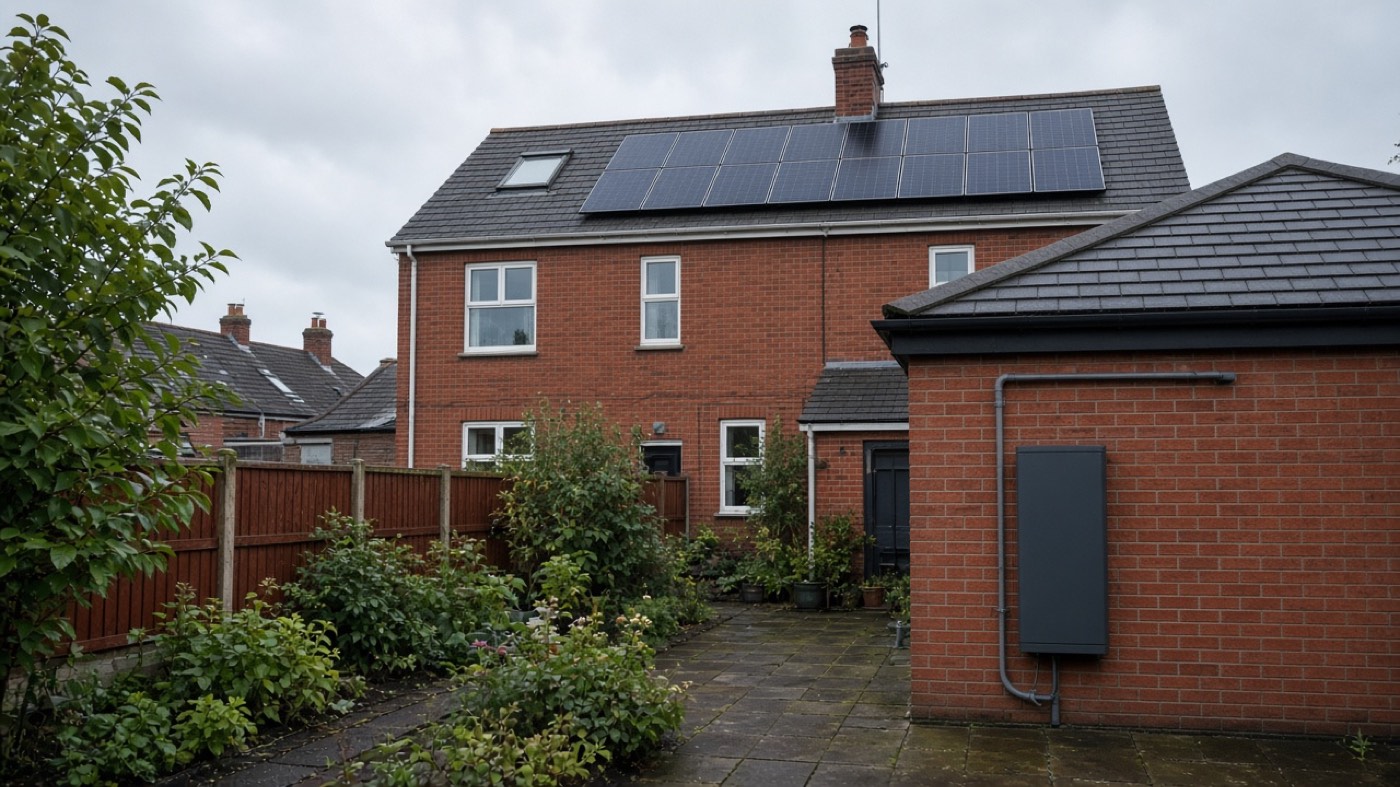
Norwich has flint and brick historic streets, terraces and a wide suburban ring. The centre is conservation-sensitive.
The houses, not the postcode average
The suburbs are a normal battery market. Suburban pitches are the productive ones. Historic roofs may not accept visible panels even when the orientation is excellent.
UK Power Networks covers the East. A G99 application is still required above the G98 threshold, and the calendar time belongs in the customer programme.
The historic centre is the awkward carry. Suburban drives are not.
What gets fitted here
Owner-occupied houses adding a hybrid system, sometimes with an EV, are the core enquiry.
East Anglia can be bright and still has short days. Model both.
UK Power Networks, yield and a 4 kWp example
A 4 kWp array at 990 kWh per installed kilowatt is about 3,960 kWh a year before shade. That is the local ceiling on solar charging, not a promise the battery will cycle fully in January.
In Norwich, on UK Power Networks, 5 kW sits above the 3.68 kW G98 line, so this wants a G99 application before anyone energises it. Export can still be capped. Agree that before the inverter is ordered. The figure uses 13.5 kWh and 4 kWp, which is enough to tell two quotes apart if they assumed something else.
Take a 13.5 kWh pack, cycled about 260 times, at 90% round trip. Charge at 13.0p, and value what comes back at 26.0p. Export given up is priced at 4.0p. About 2006 kWh a year of the charge is treated as spare solar from 4 kWp that might otherwise have been exported. Delivered energy is about 3159 kWh. After charging cost and lost export, the figure saves about £562 a year. Set that against £7,965 fitted, which is a September 2026 illustration at the temporary 0% residential rate, not a quote. That is a simple payback of about 14.2 years on these assumptions. Nudge the night rate up by 4p and see if you still like it.
What I would not sign in Norwich
Where the job is a qualifying install in a home, the 0% rate runs to 31 March 2027 and is due to become 5% after that. This figure prices the work at £7,965 on that basis. It does not apply to a shop, and it does not apply to a battery you buy and fit yourself.
I would not pay the bulk of £7,965 before the DNO route for a 5 kW inverter is known.
The flint centre and the suburban ring are different trades. Price the ring if that is where the house is.
Common questions
Is the price on this page a quote?
No. £7,965 is a September 2026 illustration for a 13.5 kWh example at the temporary 0% residential rate. Your survey replaces it.
Will it stay on in a power cut?
Only if a gateway or essential-load board was designed and paid for. A standard grid-tied battery turns off with the grid. On this 13.5 kWh example the inverter is 5 kW, and backup is still a separate line.
What paperwork should I keep?
Keep the MCS certificate where the job is certified, the electrical certificate, the DNO record, the schematic, the warranty registration and a photo of the schedule. For an illustrated £7,965 job, that folder is part of what you bought.
What if the cheap rate is not 7p?
Then the figure changes. This page used 13.0p as a charge rate and 26.0p as the rate avoided. A smaller gap means a worse payback. Read the live tariff.
Sources
Want a price for your house?
The figures above are a rough guide. An installer still needs to see your fuse board, where the battery will go, and whether you want power during a blackout.