
Quick answer
An AC-coupled battery has its own inverter and connects to your home's wiring next to the consumer unit, so your existing solar inverter stays. A hybrid inverter replaces your solar inverter and runs the panels and the battery from one box. AC-coupled is usually best when your current inverter is healthy; a hybrid is usually best for new solar or when the old inverter is near the end of its life.
- AC-coupled: keep your solar inverter, add a battery with its own inverter
- Hybrid (DC-coupled): one inverter for panels and battery, slightly more efficient
- AC-coupled is the usual retrofit; hybrid is the usual choice for new systems
- Both qualify for 0% VAT on home installs until 31 March 2027
What AC-coupled means
Solar panels make direct current (DC). Your home runs on alternating current (AC). A solar inverter converts one into the other. An AC-coupled battery connects on the AC side of the house, which is why it does not care what brand your solar inverter is.
When your panels produce more than the house is using, the surplus flows towards the meter. A current clamp sees it and tells the battery inverter to charge. Later, when the house draws from the grid, the battery inverter discharges to cover it. The solar system and the battery work side by side without being wired into each other.
What a hybrid inverter does differently
A hybrid inverter is a solar inverter with a battery connection built in. The panels and the battery both connect to it on the DC side. Solar can charge the battery directly, and the inverter converts to AC only when the house needs power. That saves one conversion step for solar energy, which is why hybrid systems are described as DC-coupled. Our full explainer covers how hybrid inverters work.
AC-coupled vs hybrid compared
The right choice depends more on your existing equipment than on efficiency figures. Here is how the two compare on the things that matter in a real house.
| Factor | AC-coupled battery | Hybrid inverter (DC-coupled) |
|---|---|---|
| Existing solar inverter | Stays and keeps working | Replaced by the hybrid |
| Round-trip efficiency on solar | Slightly lower, about 85 to 90% | Slightly higher, about 90 to 95% |
| Disruption | Battery and board connection only | Inverter swap and rewiring the panel strings |
| Best for | Retrofits with a healthy inverter | New solar, or replacing an old inverter |
| Monitoring | Two apps unless the brands match | One app for panels and battery |
| Feed-in Tariff systems | Usually simpler to keep the meter clean | Needs careful metering design |
| Typical 10 kWh cost | £4,500 to £6,500 | £5,500 to £8,000 including the new inverter |
| Example brands | GivEnergy AC, Tesla Powerwall 2, Enphase IQ, Fox AC | Fox ESS H1, SolaX, Sunsynk, Huawei, Sigenergy |
Efficiency: does it really matter?
AC-coupled systems convert solar power more times: DC to AC in the solar inverter, AC to DC to charge the battery, then DC to AC again when it discharges. Each step loses a little. A hybrid skips the first step for energy going into the battery. In practice the difference is a few percent of the energy that passes through the battery.
On a 10 kWh battery that stores about 2,500 kWh a year, a 4% difference is about 100 kWh, worth around £25 a year at typical import prices. That rarely justifies replacing a healthy inverter that would cost £1,000 or more to swap. It does make a hybrid the sensible default when you are buying an inverter anyway. See round-trip efficiency in plain numbers.
Which one should you choose?
Choose AC-coupled if your solar inverter is under about eight years old and working well, if you are on the Feed-in Tariff and want the simplest metering, or if you have a microinverter or optimiser system you want to keep.
Choose a hybrid if you are fitting solar and a battery together, if your current inverter is over about ten years old or showing faults, or if you want one app and one warranty for the whole system. Our guide to adding a battery to existing solar walks through the decision with costs.
- Healthy inverter: AC-coupled
- Old or failing inverter: hybrid
- New solar and battery together: hybrid
- Feed-in Tariff and nervous about metering: AC-coupled
- Want whole-home backup: ask about the gateway on either design
Backup and network approval
Neither design guarantees power in a power cut. Both need backup hardware, either a gateway or an essential-loads output, and an earthing arrangement for when the house is cut off from the grid. See which batteries work in a power cut.
For network approval, an AC-coupled battery adds a second inverter, so the network looks at the combined capacity of both. That can push a retrofit from G98 into G99 or require export limitation. A hybrid swap may keep the total lower. Ask the installer which route applies; see G98 and G99.
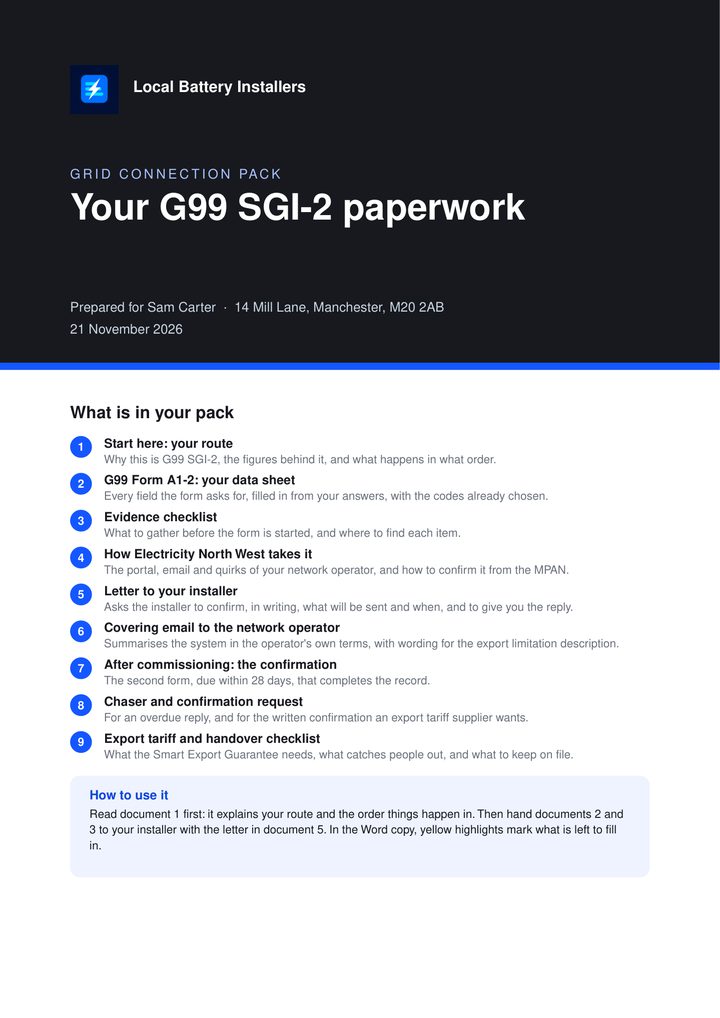
G98 and G99 paperwork
Not sure which form your system needs?
The free route finder works out whether your solar or battery is G98, or G99 SGI-1, SGI-2 or SGI-3, from the inverter sizes. The £19 pack then fills in the form data, the evidence checklist and the letters for your network operator.
Frequently asked questions
What is an AC-coupled battery?
A battery with its own inverter that connects to the AC wiring of the house. It works beside any existing solar inverter without replacing it.
Is AC-coupled or DC-coupled better?
DC-coupled hybrid systems are slightly more efficient for storing solar. AC-coupled is usually better for retrofits because it keeps a working solar inverter.
Can I add an AC-coupled battery to any solar system?
Almost any. It does not need to match the solar inverter brand, though the combined inverter capacity affects the network application.
Do I lose my Feed-in Tariff with an AC-coupled battery?
No, if it is installed so the generation meter only records solar. Tell your FIT supplier before the work.
Want a real price for your home?
Figures here are a guide. An installer still needs to see your fuse board, where the battery will go and whether you want backup. Tell us your postcode and local installers will quote.
Related guides


