

How the route is decided
Two engineering recommendations from the Energy Networks Association set the rules for connecting generation to a home's supply in England, Scotland and Wales: EREC G98 for small systems and EREC G99 for everything else. Which one applies comes down to amps per phase, worked out from each inverter's output at 230 volts. On a single-phase supply 3.68 kW is 16 A.
Three numbers matter: the largest single unit, the total of every unit at the property including batteries and anything already there, and whether an export limitation scheme caps what the home can send to the grid.
| Procedure | Each unit | All units together | Export limit | When you tell the DNO | Form |
|---|---|---|---|---|---|
| EREC G98 | 16 A or less | 16 A or less | Not needed | Within 28 days after commissioning | G98 Form B |
| G99 SGI-1 | Design capacity up to 32 A, output limited to 16 A | 16 A or less | Not needed | After installation | Form A3-3 |
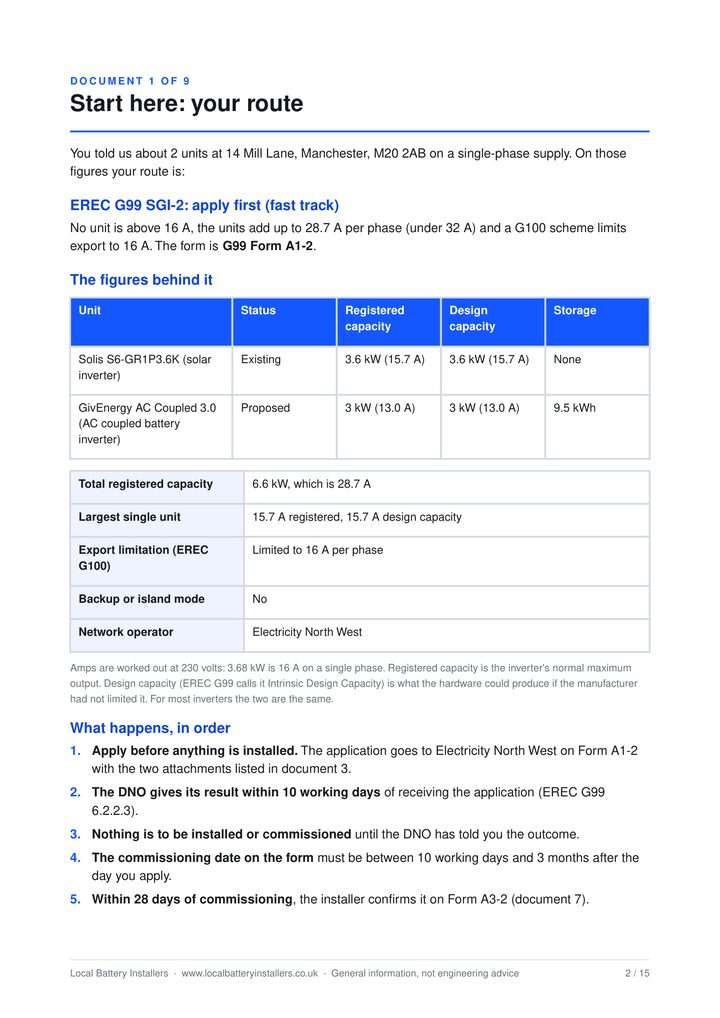
| G99 SGI-2 | 16 A or less | Less than 32 A | G100 scheme at 16 A | Before installing. Result in 10 working days | Form A1-2, then A3-2 |
| G99 SGI-3 | Design capacity up to 32 A | Less than 60 A | G100 scheme at 32 A, waived at 32 A or less | Before installing. Answer on further analysis in 10 working days | Form A1-2, then A3-2 |
| G99 standard | Anything larger, or not type tested | Under 17 kW single-phase, 50 kW three-phase | Detailed on a separate sheet | Before installing. Up to 45 working days for an offer | Form A1-1 |
Storage counts as generation. That is why adding a battery to a home with solar so often tips a system out of G98: the two inverters are added together even if they never run flat out at the same time.
Why it matters to you and not only the installer
- The order of events changes. Under SGI-2, SGI-3 and Form A1-1 nothing should be installed until the network operator has answered. A booking made before that can slip by weeks.
- You need the reply for export payments. SSEN notes that most suppliers require the network operator's response before you can apply for an export tariff.
- It follows the house. A buyer's solicitor can ask for proof that the system was notified. If the installer has ceased trading, the record is the only proof there is.
- Later upgrades start from it. A second battery or a bigger inverter is assessed against what the network operator already holds for your address.
What is in the pack
The route finder above is free. The pack is the paperwork for the route it gives you, written from your own figures, for £19.
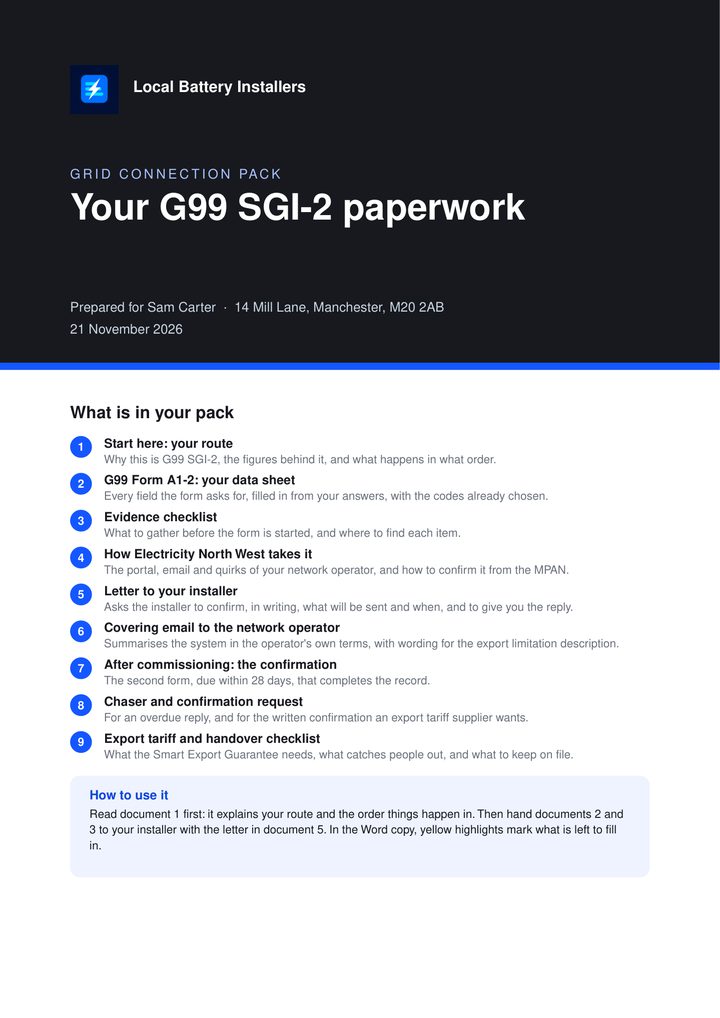
| Document | What it does |
|---|---|
| 1. Start here: your route | Why this is G99 SGI-2, the figures behind it, and what happens in what order. |
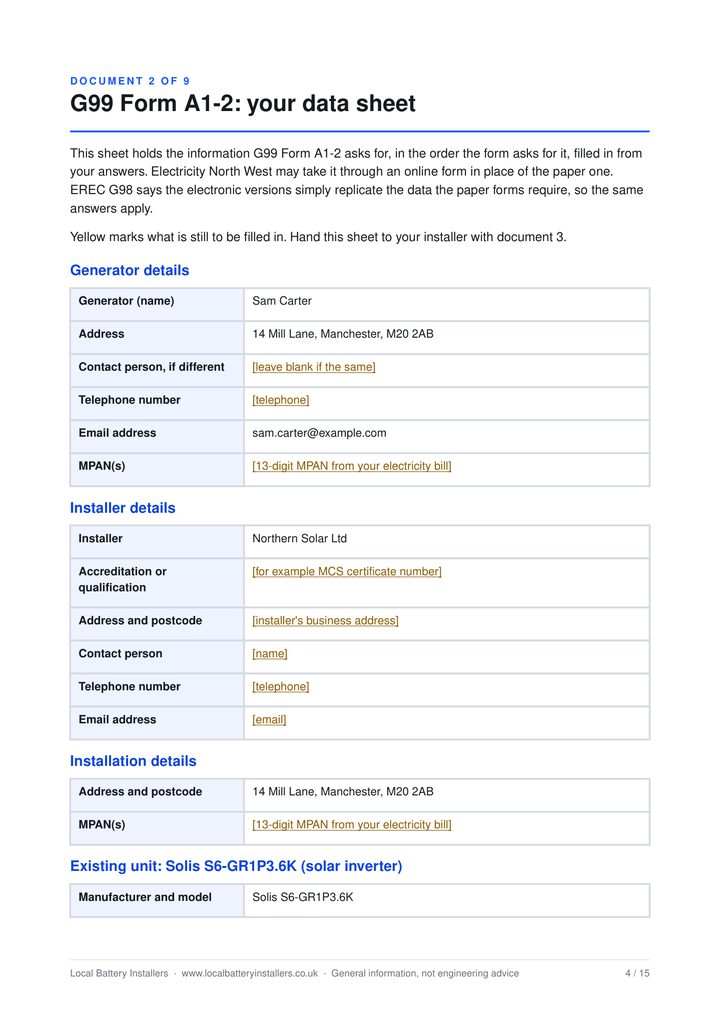
| 2. G99 Form A1-2: your data sheet | Every field the form asks for, filled in from your answers, with the codes already chosen. |
| 3. Evidence checklist | What to gather before the form is started, and where to find each item. |
| 4. How Electricity North West takes it | The portal, email and quirks of your network operator, and how to confirm it from the MPAN. |
| 5. Letter to your installer | Asks the installer to confirm, in writing, what will be sent and when, and to give you the reply. |
| 6. Covering email to the network operator | Summarises the system in the operator's own terms, with wording for the export limitation description. |
| 7. After commissioning: the confirmation | The second form, due within 28 days, that completes the record. |
| 8. Chaser and confirmation request | For an overdue reply, and for the written confirmation an export tariff supplier wants. |
| 9. Export tariff and handover checklist | What the Smart Export Guarantee needs, what catches people out, and what to keep on file. |
The documents change with your answers. A connect and notify system gets the notification form's data sheet and no commissioning follow-up. An installer gets a request to send the customer in place of the letter to the installer. A system that is already installed gets a tenth document on putting right an installation the network operator has no record of. Download the full sample, written for an example home in Manchester adding a battery to existing solar.
Who it is for
- Homeowners planning solar or a battery who want to know the timetable before they sign a quote.
- Owners who cannot get proof from their installer that the network operator was told.
- People who bought a house with solar or a battery and have no paperwork for it.
- Electricians and small installers who want the form data and customer letters prepared.
It is not for systems of 17 kW or more on a single-phase supply or 50 kW or more on three-phase, which use the network operator's Standard Application Form, or for Northern Ireland. To find your network operator on its own, use the free DNO lookup. For how the rules work in more depth, read G98 and G99 for home batteries.
Sources
- ENA Engineering Recommendation G98, Issue 2 (2025)
- ENA Engineering Recommendation G99, Issue 2 (2025)
- ENA Connect Direct and the Type Test Register
- Electricity Safety, Quality and Continuity Regulations 2002, regulation 22
- Ofgem: Smart Export Guarantee guidance for generators
- UK Power Networks Smart Connect
- National Grid: fast track (G99)
- SSEN: G99 fast track process
- Northern Powergrid: Form A1.2 download
- Electricity North West: generation and storage
- SP Energy Networks: G99 generator connections
Rules and network operator processes read on 21 November 2026.
Frequently asked questions
What is the difference between G98 and G99?
G98 covers small systems where every inverter is fully type tested and the total is no more than 16 A per phase, which is 3.68 kW on a single-phase supply. You install first and the installer notifies the network operator within 28 days. G99 covers everything larger. Since 9 November 2022, according to the Energy Networks Association, it has had three fast track procedures for small installations, called SGI-1, SGI-2 and SGI-3, and a standard application on Form A1-1.
Does a battery count towards the limit?
Yes. Electricity storage counts as generation, so a battery inverter is added to any solar inverter already at the property. A 3.6 kW solar inverter with a 3 kW battery inverter is 6.6 kW in total, which is over the G98 limit even though neither unit is on its own.
Do I need approval before installing a home battery?
Only if the system is above the connect and notify limits. Under G98 and G99 SGI-1 you install first and notify. Under SGI-2, SGI-3 and Form A1-1 nothing should be installed or commissioned until the network operator has answered. The route finder on this page tells you which applies.
How long does a G99 application take?
On the fast track, the network operator gives its result within 10 working days for SGI-2, and confirms within 10 working days whether it needs more analysis for SGI-3. A standard application on Form A1-1 can take up to 45 working days for a low voltage connection offer.
Can I send the application myself?
The forms carry an installer's declaration and signature, and UK Power Networks says only installers can notify it. SSEN recommends the installer completes the notification. So the installer normally submits. What you can do is hand them complete information, check it was sent, and get the reply, which is what the pack is built for.
Is the pack the official form?
No. The official forms belong to the Energy Networks Association and your network operator, and several operators now use online forms in their place. The pack is your answers laid out in the order the official form asks for them, with the energy source and technology codes chosen, so the form or portal can be completed in one sitting.
What does a DNO application cost?
A G98 or SGI-1 notification is free. For a standard G99 application a network operator can charge assessment and design fees, and you pay for any network upgrade your system needs. UK Power Networks says there is nothing to pay where the supply does not need upgrading. Ask for the fee before you apply.
My installer has already notified the DNO. Do I need this?
No. Ask the installer for a copy of what was sent and the network operator's reply, and keep both. The pack is for when you are planning a system, when you cannot get that evidence, or when you are an installer who wants the paperwork prepared.
What if my system was never notified?
Choose already installed when you order. The pack then includes a letter to the network operator for an existing installation and the steps to take first, including what to do if the installer has ceased trading.
Does it cover Scotland, Wales and Northern Ireland?
It covers England, Scotland and Wales, where all six regional network operators use G98 and G99. It does not cover Northern Ireland, where NIE Networks uses its own G98/NI and G99/NI forms.
What if it is not what I expected?
Reply to the delivery email within 14 days and we will put it right or refund you.