
Quick answer
Yes, you can add a battery to almost any existing solar system in the UK. You either fit an AC-coupled battery with its own inverter beside the one you have, or replace your solar inverter with a hybrid that runs the panels and the battery together. The choice mostly comes down to the age of your inverter and the network limit: the Energy Networks Association counts every inverter at the address together, so an AC-coupled battery added to a typical 3.68 kW solar inverter takes a single-phase home past the G98 limit and into a G99 application, while a 3.68 kW hybrid swap does not. Our planning range is £3,000 to £8,000 fitted, usually one day on site, at 0% VAT until 31 March 2027.
- Healthy inverter under about 8 years old: an AC-coupled battery keeps it and means less disruption
- Inverter over about 10 years old or failing: a hybrid swap replaces it once and keeps one inverter on the property
- G98 covers up to 16 A per phase, 3.68 kW single phase, counted across all inverters (ENA, March 2026)
- SEG can continue with a battery if the export meter can still separate solar export (Ofgem co-location guidance)
- MCS says a certified installer can add a battery to existing solar and you get a certificate within 10 working days
Two ways to add a battery to solar
This page is for homes that already have panels on the roof. If you are still choosing a solar quote and want to leave room for a battery, read solar now, battery later instead, because the day-one inverter choice changes the answers below.
Every retrofit starts with the solar inverter already on your wall. That box converts the DC from the panels into AC for the house, and it decides which battery options make sense.
The first route is an AC-coupled battery. The battery comes with its own inverter and connects on the AC side of the house, next to the consumer unit. Your existing solar inverter stays exactly as it is. When the panels make more than the house is using, a clamp on the meter cable sees the surplus and the battery soaks it up instead of exporting it.
The second route is a hybrid inverter swap, often called DC coupling. The old solar inverter comes off the wall and a hybrid inverter goes in its place. The panels and the battery both connect to the hybrid, so solar can charge the battery on the DC side without converting it twice. Our explainer on what a hybrid inverter does goes into more detail.
| AC-coupled battery | Hybrid inverter swap | |
|---|---|---|
| Existing inverter | Stays in place | Removed and replaced |
| Disruption | Battery and a connection at the board | Battery, new inverter and rewiring the solar strings |
| Inverters on the property | Two, both counted by the network | One |
| Our planning range (10 kWh) | £4,500 to £6,500 | £5,500 to £8,000 |
| Best when | Inverter is under about 8 years old and healthy | Inverter is old, failing or out of warranty |
What you have now and what to fit
Look at the label on your solar inverter, the date on your installation certificate and your supply (most homes are single phase). Then find your row below. Where two rows apply, the network row usually decides, because a G99 application adds weeks before the battery can be switched on.
| What you have now | What to fit | Why |
|---|---|---|
| String inverter under about 8 years, working | AC-coupled battery | Keeps a healthy inverter |
| String inverter over about 10 years or faulty | Hybrid swap (DC coupled) | Replaces it once, not twice |
| 3.68 kW inverter, single phase, want G98 | Hybrid swap at 3.68 kW | Inverter total stays at 3.68 kW |
| Enphase or other microinverters | AC-coupled battery | No DC string for a hybrid |
| SolarEdge with optimisers | SolarEdge battery or AC-coupled | Optimisers need a SolarEdge inverter |
| Feed-in Tariff system | AC-coupled, after the generation meter | Meter keeps counting solar only |
| Want power in a power cut | Either, with a backup switch | Island mode rules out the G99 fast track |
- String inverters tend to last 10 to 15 years. If yours is near that age, a hybrid now saves paying for a new inverter separately in a few years
- SolarEdge homes: see adding a battery to SolarEdge
- SMA and Fronius inverters are usually kept with an AC-coupled battery: see batteries on SMA or Fronius
- Two arrays on different roofs: check both feed the plan, see two arrays and one battery
- Thinking about the swap: read replacing a string inverter with a hybrid first, as the hybrid must suit your panel strings
Worked example: G98 headroom when you add a battery
The Energy Networks Association's Distributed Generation Connection Guide (March 2026) says electricity storage is classed in GB law as a form of generation, and that for inverter-connected units the route is based on the total installed capacity of all the generating units. G98, the fit and notify route, covers up to 16 A per phase, which the guide puts at 3.68 kW on a single-phase supply and 11.04 kW on three phase. The installer must notify the network operator within 28 days of commissioning. The guide also says that where storage is used with solar to offset consumption, the total is likely to be above 16 A per phase, so G99 applies.
Take a common single-phase home: a 4 kWp array on a 3.68 kW solar inverter, notified under G98 when it was fitted. Option one adds an AC-coupled battery. GivEnergy's AC Coupled datasheet (V2.0, November 2025) lists a nominal AC output of 3,000 W, so the property now has 3.68 plus 3.0, which is 6.68 kW of inverters. That is well above 3.68 kW, so the battery needs a G99 route before it is switched on. Option two swaps the solar inverter for a hybrid rated at the G98 ceiling. Fox ESS's H1 G2 datasheet (V2.2, June 2026) lists 3,680 W for the 3.7 kW model with a note that this is the G98 setting. The panels and battery then share one 3.68 kW inverter, the total does not rise, and the installer notifies within 28 days.
GivEnergy is used here only for its rating; the company has been in administration since April 2026, see GivEnergy administration.
| Setup | Inverters counted | Total | Network route |
|---|---|---|---|
| Solar only, today | 3.68 kW | 3.68 kW | G98, already notified |
| Add AC-coupled battery | 3.68 kW + 3.0 kW | 6.68 kW | G99, fast track possible |
| Swap to 3.68 kW hybrid | 3.68 kW | 3.68 kW | G98, notify in 28 days |
| AC-coupled with backup | 3.68 kW + 3.0 kW | 6.68 kW | Standard G99 |
If you land in G99
G99 is not a refusal. The ENA guide says network operators run a fast track for some domestic storage using the G99 Form A1-2, which cuts the time for the operator to confirm whether the connection is acceptable from 45 days to 10 days or less. It also says the fast track does not apply where the storage is designed to run the house in a power cut (island mode); those jobs use the standard G99 process. Export limitation, set in the inverter settings, is the usual way an installer keeps the effective export within what the network will accept. Our G98 and G99 guide covers the forms, and the grid connection pack prepares them.
Two smaller points from the same guide. Storage installed after March 2026 must switch from import to export mode if the grid frequency falls below a set threshold, which is a setting in compliant kit, not something you arrange. And National Grid Electricity Distribution's G98 notification asks for 'the device reference number(s) of any new or existing generation devices', so your existing solar inverter has to be listed as well as the battery.
How much does adding a battery to solar cost?
Retrofits avoid the roof work and scaffolding of a new solar job. The figures below are our planning ranges for 2026, fitted at 0% VAT, not quotes. A backup switch, a consumer unit upgrade or a long cable run to a garage will add to them. We have not tested any of these products.
We looked for published guides that price a battery added to existing solar on its own, checked 27 Nov 2026, and found three: Expertsure (updated October 2026) puts a battery added on its own at about £3,900 to £9,000 installed depending on capacity, EnergyPlus (August 2026) gives £3,000 to £10,500 for most retrofits, and Solar4good, an installer, gives £4,000 to £11,000 (June 2026, coupling not stated). That is fewer than the eight sources we look for on a price claim, so treat our ranges as planning figures. Both guides that split by size put a 10 kWh AC-coupled retrofit above our range, so a quote of up to about £8,500 is not out of line.
For prices by brand, see home battery cost in the UK.
| Retrofit | Our planning range | EnergyPlus | Solar4good (coupling not stated) |
|---|---|---|---|
| 5 kWh AC-coupled battery | £3,000 to £4,500 | £3,000 to £5,500 | £4,000 to £6,000 |
| 10 kWh AC-coupled battery | £4,500 to £6,500 | £5,000 to £8,500 | £6,000 to £9,000 |
| Hybrid inverter swap plus 10 kWh | £5,500 to £8,000 | £5,800 to £10,000 | Not given |
| Tesla Powerwall 3 (13.5 kWh) | £8,000 to £11,000 | £7,500 to £10,500 | 13.5 kWh: £7,500 to £11,000 |
What size battery to add
Size the battery to your evening and overnight use, not to the size of your roof. A typical 3 bed home uses 5 to 8 kWh between teatime and breakfast. A 4 kWp array will fill a 10 kWh battery on a good summer day, but in winter the battery will mostly be filled from a cheap overnight tariff, if you have one.
If your array is small, around 2 kWp, a 5 kWh battery is often enough for solar alone; see a battery on a small 2 kWp array. If you have a 4 kWp array, see adding a battery to a 4 kWp array. A bigger battery only pays if a tariff or a heat pump gives it work to do all year.
SEG payments when you add a battery
Ofgem's co-location guidance (version 6.2, May 2025, Appendix 3) says you can add battery storage to an installation receiving Smart Export Guarantee payments as long as the export meter can still measure what the solar exported separately from any other source. What your export supplier must pay then depends on how the battery is set up.
If you plan to charge the battery overnight on a cheap tariff, ask your SEG supplier how it will treat that before the battery goes in; Ofgem advises checking with the licensee before changing the storage. A battery also means you export less, because you store surplus to use later. That is usually the better deal, as a unit you avoid buying in the evening is worth more than a unit you sell at midday. See export or store solar and the SEG with a battery.
| How the battery charges | Ofgem's view of SEG |
|---|---|
| Solar only, inverter blocks grid charging | Supplier must pay on export |
| Solar only, relay stops charging during import | Supplier must pay on export |
| Solar and grid, battery import metered | Not obliged; may pay on calculated green export |
Feed-in Tariff homes
Plenty of older systems are still on the Feed-in Tariff, which pays for every unit the panels generate. You can add a battery to a FIT system. Ofgem's co-location guidance says there must be no risk that FIT payments are claimed on electricity the solar did not generate, and it names electricity imported from the grid. In practice that means the generation meter must only measure solar, never battery output that was charged from the grid. An AC-coupled battery wired after the generation meter usually keeps this clean. Tell your FIT supplier before the work and keep the commissioning paperwork. Our guide to batteries and the Feed-in Tariff explains the detail.
MCS certificate and the paperwork you should get
MCS says that if you already have solar panels a certified installer can connect a battery to your existing system, and that you receive an MCS certificate within 10 working days of completion. Use an MCS certified installer for the battery and keep the battery certificate with the original solar one. Your SEG supplier and any future buyer of the house may ask for both.
The installation itself normally takes one day. At handover you should receive the items below. If any is missing, ask before the final payment.
- Electrical installation certificate for the new circuit
- MCS certificate for the battery, within 10 working days
- The network operator's G98 acknowledgement or G99 approval, showing the new inverter total
- Inverter settings that match what you told your SEG supplier, for example grid charging on or off
- Warranty registration and a simple diagram of what was fitted
- A note to your FIT supplier, if you have one, before the work starts
VAT on a battery added to solar
GOV.UK VAT Notice 708/6 zero-rates the installation of batteries in homes, including batteries retrofitted to existing solar, until 31 March 2027, after which the rate is due to be 5%. A battery bought without installation is standard-rated. See 0% VAT on home batteries for how deposits and dates work.
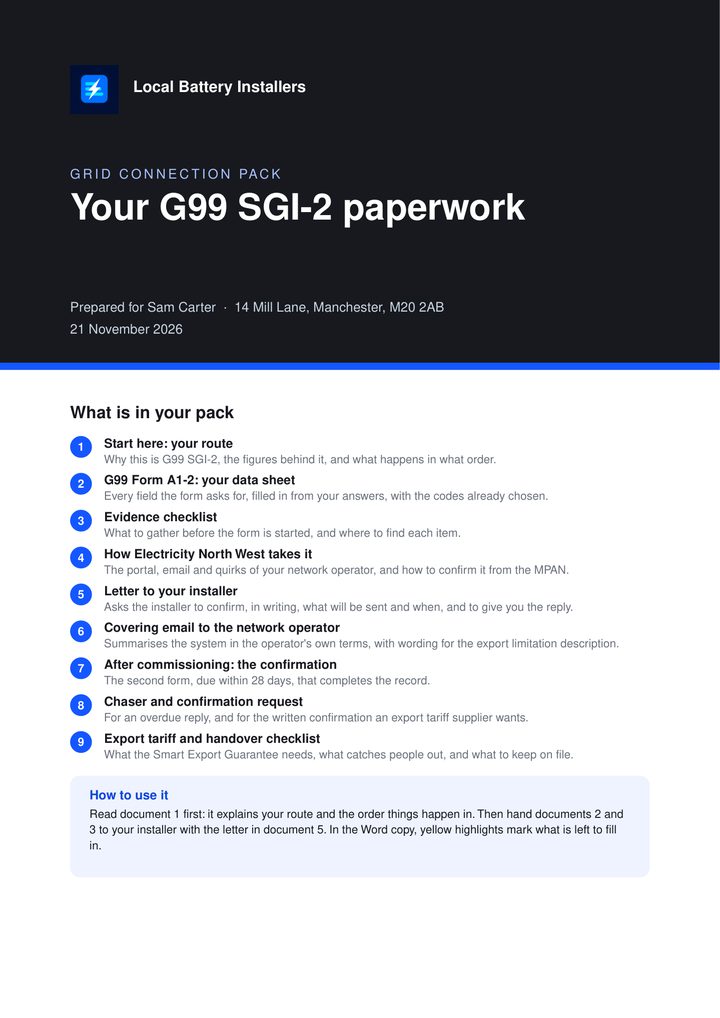
G98 and G99 paperwork
Not sure which form your system needs?
The free route finder works out whether your solar or battery is G98, or G99 SGI-1, SGI-2 or SGI-3, from the inverter sizes. The £19 pack then fills in the form data, the evidence checklist and the letters for your network operator.
Frequently asked questions
Can I add a battery to my existing solar panels?
Yes. Almost every UK solar system can take a battery, either AC-coupled beside the existing inverter or by swapping to a hybrid inverter. MCS says a certified installer can connect a battery to an existing system.
Should I choose AC or DC coupling for a retrofit?
Keep a healthy inverter under about 8 years old and add an AC-coupled battery. If the inverter is over about 10 years old, faulty, or you want to stay within G98 on a single-phase supply, swap it for a hybrid (DC coupled).
Will adding a battery take me over the G98 limit?
Often, yes. G98 covers up to 3.68 kW single phase across all inverters. A 3.68 kW solar inverter plus a 3 kW AC-coupled battery inverter is 6.68 kW, so it needs G99. A 3.68 kW hybrid swap keeps the total at 3.68 kW.
How much does it cost to add a battery to existing solar?
Our planning range is £3,000 to £4,500 for 5 kWh and £4,500 to £6,500 for 10 kWh with an AC-coupled battery, and £5,500 to £8,000 for a hybrid swap with 10 kWh, fitted at 0% VAT.
Will adding a battery stop my SEG payments?
Not if the export meter can still separate solar export. Ofgem says suppliers must pay where the battery can only charge from solar. If it can also charge from the grid, the supplier is not obliged to pay, so check first.
Will adding a battery affect my Feed-in Tariff?
Not if it is installed correctly. The generation meter must only record solar. Tell your FIT supplier and keep the installer's commissioning paperwork.
Do I need a new MCS certificate when I add a battery?
Yes, ask for one. MCS says you receive an MCS certificate within 10 working days of a certified installer completing the job. Keep it with your original solar certificate.
Is adding a battery to solar 0% VAT?
Yes. Retrofitting a battery to a home is 0% VAT until 31 March 2027 when it is supplied and installed together.
Want a real price for your home?
Figures here are a guide. An installer still needs to see your fuse board, where the battery will go and whether you want backup. Tell us your postcode and local installers will quote.
Related guides


Sources
- ENA Distributed Generation Connection Guide, March 2026 (via Northern Powergrid)
- National Grid Electricity Distribution: Micro generation single premises (G98)
- Ofgem: Co-location of electricity storage under the RO, FIT, REGO and SEG, version 6.2
- Ofgem: Co-location guidance for generators v6.2 (PDF, Appendix 3 on SEG)
- Ofgem: Smart Export Guarantee, generators
- MCS: Battery storage
- GivEnergy: AC Coupled Inverter datasheet, V2.0 Nov 2025
- Fox ESS: H1 (G2) / AC1 (G2) datasheet, V2.2 June 2026
- Expertsure: How much do solar panels cost? (battery costs section, checked 27 Nov 2026)
- EnergyPlus: Cost to add a battery to existing solar panels, UK 2026 (checked 27 Nov 2026)
- Solar4good: Battery storage for existing solar panels, UK retrofit guide 2026 (checked 27 Nov 2026)
- HMRC: VAT Notice 708/6, energy-saving materials (updated 31 Jan 2024, checked 29 November 2026)
- Ofgem: Feed-in Tariffs