
Quick answer
A home battery does not invent a free choice between storing solar and exporting it. Every midday kilowatt hour from the roof can only go one primary way at a time: into the house loads, into the pack, or out through the meter under a Smart Export Guarantee (SEG) deal. Filling the battery for the evening usually beats a weak export rate when you would otherwise buy peak electricity later. Selling midday units can win when the pack is already full, when your export rate is unusually strong, or when the evening you are saving for never needed that much import anyway. Round-trip losses mean some energy disappears as heat in the inverter and cells, so storing is not a perfect bank. The right default is a control mode that covers the evening house first, exports only the true surplus, and does not thrash the pack for pennies.
Three places a midday solar unit can go
Picture a bright late morning on a south-facing UK roof. The kettle is off. The washing machine has finished. The inverter is still making power. That surplus has to go somewhere. If the house can use it instantly, that is the best outcome: you avoid importing at your daytime rate without any battery wear. If the house cannot use it, the hybrid or battery inverter either charges the pack or exports to the street.
Ofgem describes the Smart Export Guarantee as the scheme that requires licensed suppliers to pay small-scale low-carbon generators for electricity they export. In practice you choose a SEG tariff, meet the metering rules, and get paid per exported kilowatt hour. Energy Saving Trust guidance on solar panels still frames export income as one part of the story, not the whole bill. Self-use of solar, and later of stored solar, often moves more money than the export line alone.
A battery changes the timing, not the physics. Energy you store at noon can run the lights, the fridge and the heat pump after dark. Energy you export at noon becomes a credit on the statement and is gone from the cupboard. You cannot spend the same unit twice. Households that stare at a live export graph and a live battery graph at the same time sometimes feel cheated when one rises and the other does not. That is the system working as designed.
When filling the pack for evening use is the better trade
Most UK homes on ordinary import rates pay far more for an evening kilowatt hour than they earn for a midday export kilowatt hour. If your SEG rate is a few pence and your evening import is several times that, every unit you can shift into the evening without buying from the grid is doing useful work. The battery exists for that shift.
Work a simple example with your own numbers, not a brochure. Suppose export pays 5p and evening import costs 25p. Store 1 kWh at noon, lose a bit on the way through the pack, and deliver about 0.9 kWh at 19:00. You avoided roughly 22p of import and gave up 5p of export, so the storage decision is still ahead even after losses. Change the rates and the answer changes. A generous export product and a mild evening load can flip it.
Evening peaks are not only about money. They are when the street is busy and when heat pumps, cookers and chargers stack. Using stored solar then cuts import at the worst time of day for both your bill and the local network. MCS-certified kit and a competent commissioning visit should leave you with a mode that prefers self-consumption into the battery before spilling export, unless you deliberately choose something else.
Winter complicates the romance. Short days and low sun mean the pack may never fill from the roof alone. Then the question is not export versus store of abundant solar. It is whether to top up from cheap overnight grid units, leave a reserve, or accept more evening import. That is a tariff and schedule problem sitting on top of the solar one.
When selling midday units wins
Export wins when the battery cannot usefully take more. A full pack on a bright Saturday, with the family out and the car away, should spill to the grid rather than idle the inverter for no reason. Blocking export while the cells sit at 100 percent does not create future energy. It just clips generation or forces the inverter to throttle.
Export can also win on paper when your SEG rate is high relative to the value of shifting energy. Some supplier products pay more for export at certain times, or pair solar with a time-of-use import rate such as Octopus Flux-style tariffs that already cheapen overnight charging of the pack from the grid. In those setups the battery may be told to sell or to buy on a schedule that looks odd if you only think in solar-first terms. Read the tariff rules. Then set the inverter modes to match them. Guesswork in the app is how people export at the wrong hour and import at the expensive one.
There is a third case: you simply do not need the stored energy. A household that is empty from Friday to Sunday in summer, with no heat pump load and no EV at home, may fill a modest pack by late morning and then correctly export for two days. Buying a bigger battery only to avoid export is a capital decision, not a moral duty. Compare the extra cupboard cost with the extra SEG income and the extra evening coverage you would actually use.
Feed-in Tariff legacy sites need extra care. Older FIT metering must not count battery discharge as generation. Installers who understand FIT and SEG differences will keep the generation meter clean. If your array predates SEG and still sits on FIT, do not assume a modern export-versus-store blog post maps onto your meter cupboard without a specialist check.
Round-trip losses without the marketing gloss
Round-trip efficiency is the share of energy you get back out after you put energy in. Home batteries and their inverters are good, not perfect. Charge and discharge both waste a slice as heat. Cable runs, standby loads and poor temperature conditions nibble a little more. Treat brochure percentages as a starting point, then assume real houses do a bit worse when the cupboard is hot or the inverter is working hard.
Losses matter most when the export rate and the avoided import rate are close. If the spread is wide, a 10 percent loss still leaves storage looking sensible. If the spread is narrow, losses can erase the advantage and make immediate export the calmer choice. That is why copying a neighbour's settings is risky. Their tariff spread may not be yours.
Cycling the battery for tiny gains is another quiet loss. Some automation will charge and discharge around small price or solar wiggles all afternoon. Each cycle costs efficiency and uses cycle life. A stable plan that fills once from surplus and empties once through the evening often beats a restless graph that looks clever on a phone screen.
Calendar ageing happens whether you cycle or not. That is not a reason to leave the pack empty forever. It is a reason to use the capacity for clear, high-value shifts instead of ornamental micro-trading. Ask the installer what reserve, what maximum charge level for daily use, and what summer versus winter behaviour they recommend for your chemistry and warranty.
How to decide on a real Tuesday in your kitchen
Write four numbers on a notepad: your daytime import rate, your evening import rate if different, your SEG export rate, and a rough round-trip factor such as 0.9. Then write how many evening kilowatt hours you typically buy after dark in each season. If stored solar can displace expensive evening units, prioritise charging from the roof until the pack hits a sensible daily target, then export. If your evenings are already tiny because you are out, or because a heat pump is off, do not romanticise a full pack.
Check what the inverter is actually set to do. Self-consumption, time-of-use, and force-charge modes are different animals. A Flux-style tariff may want overnight grid charging into the battery even when the next day is sunny, because the night units are cheaper than the alternative. A simple SEG and flat import deal usually wants solar into the pack first. The badge on the cabinet does not pick the mode. The commissioning sheet and your supplier product do.
Look at a week of data, not one glorious noon. UK weather stacks dull days together. A pack that never reaches full in November is not broken. A pack that hits full by 11:00 in June and then exports all afternoon is not wasting solar. It has finished its storage job for that day.
Network limits sit underneath the money chat. A G99 export cap can force more self-use whether you like the SEG rate or not. That can make the battery more valuable, because clipped export has nowhere else to go. Keep the DNO offer with the tariff paperwork so nobody later wonders why the app shows a hard export ceiling.
- Compare SEG pence with the evening import you would otherwise buy
- Subtract a realistic round-trip loss before you call storage a win
- Export freely once the pack is full or the evening need is already covered
- Align inverter modes with the live supplier product, not a forum default
What a good installer should leave you able to explain
After handover you should be able to say, in one breath, whether today's solar surplus fills the battery first or sells first, what happens when the pack is full, and whether overnight grid charging is allowed. If you cannot say those three things, the app tour was a demonstration, not a handover.
You should also know how to read the SEG statement against the generation and export meters. Credits that arrive weeks later still need to match the story the inverter told you. MCS paperwork, electrical certificates and the network notification are the backbone. The pretty dashboard is optional.
Revisit the settings when you change supplier, add an EV charger, or replace a heat pump. Each of those changes moves the evening load or the overnight price. The export-or-store answer from last spring may be wrong by autumn. A short review visit or a clear remote reconfiguration beats a year of quiet mismanagement.
The headline is dull and useful. Store solar when it will replace expensive evening imports after losses. Export when the pack is full, when the tariff pays you properly for midday units, or when you would not have imported that energy later anyway. Everything else is detail on top of that trade.
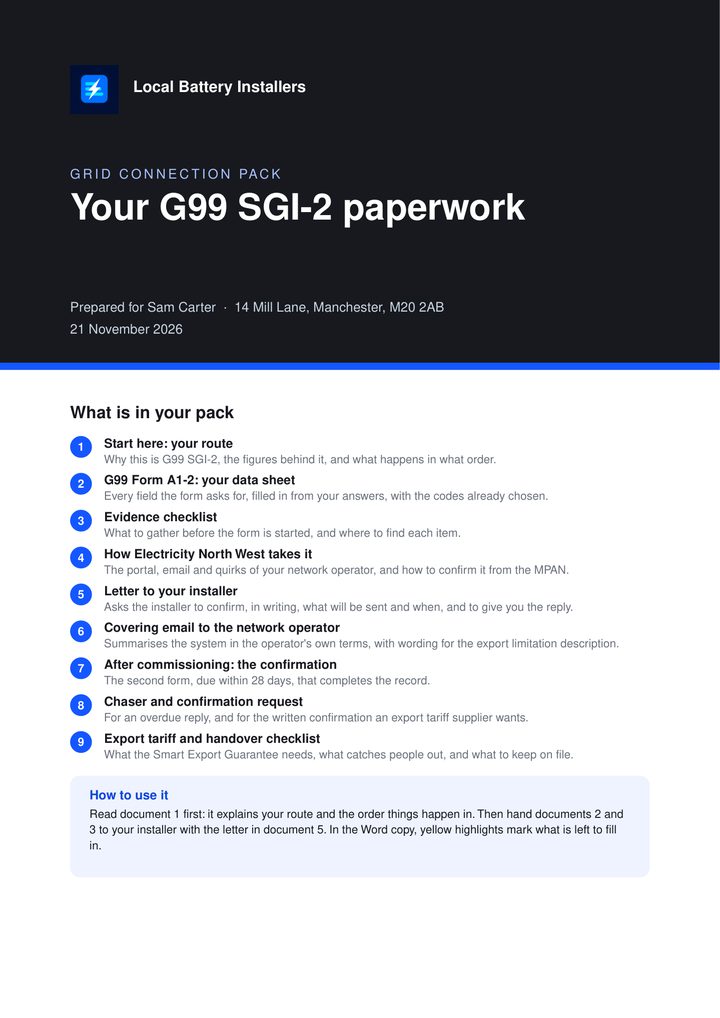
G98 and G99 paperwork
Not sure which form your system needs?
The free route finder works out whether your solar or battery is G98, or G99 SGI-1, SGI-2 or SGI-3, from the inverter sizes. The £19 pack then fills in the form data, the evidence checklist and the letters for your network operator.
Frequently asked questions
Is it wasteful to export if I own a battery?
No. A full battery should export surplus. Storage only helps if you will use the energy later or if your tariff explicitly wants a different schedule.
Do round-trip losses mean batteries are pointless?
No. Losses reduce the benefit. They do not remove it when the gap between export income and avoided evening import is wide enough.
Should I always empty the battery every night?
Not always. Leave the reserve your backup or warranty settings require. Emptying into low-value loads just to flatten the graph is not clever.
Can SEG and a time-of-use import tariff work together?
Yes, and the control logic gets more important. Products like Flux-style tariffs need modes that follow price windows, not only solar-first habits.
Who sets the export limit on my inverter?
The installer commissions it to match the network permission and the product. Ask to see the limit in the settings and on the DNO paperwork.
Want a real price for your home?
Figures here are a guide. An installer still needs to see your fuse board, where the battery will go and whether you want backup. Tell us your postcode and local installers will quote.
Related guides


