
Quick answer
Usually not, if your panels sit on a pitched roof at 15 degrees or more: UK rain washes most dirt off, and the Energy Saving Trust says routine cleaning is not essential. Cleaning is worth it on flat or shallow arrays below about 10 to 15 degrees, near farms, busy roads, the coast or trees, and where birds perch. Use soft water and a soft brush from the ground, never a pressure washer or anything abrasive, because some makers' warranties exclude that damage. Across 10 UK price sources we read, a typical home clean costs about £60 to £150 a visit, more above one storey. Check generation monthly and have the system professionally inspected every few years.
- Tilt matters most: Aiko recommends at least 10 degrees and E.ON Next says rain keeps panels clean at 15 degrees or more
- REC says pressure washers, steam cleaners and metal scourers will invalidate its warranty
- Clean early in the morning or on a dull day, with water close to the panel's temperature
- Most UK price guides put a home clean at about £60 to £150 a visit; access above one storey costs more
- The Energy Saving Trust suggests a professional service every 3 to 5 years
Do your panels need cleaning? Check your roof
Panel makers design their glass to be rinsed by rain. REC's cleaning guide says normal rainfall cleans its panels if they are installed at a sufficient angle, and recommends cleaning when you can see dirt on the glass. Aiko's installation manual recommends a tilt of no less than 10 degrees, and E.ON Next says UK rain keeps most panels clean at 15 degrees or more.
Low tilt is where dirt stays. LONGi's maintenance manual notes that on shallow roof arrays in rainy climates, water and dirt collect along the bottom edge of each panel, which can shade cells and cause local heating. That line of grime along the lower frame is the thing to look for from the garden.
| Your situation | Cleaning need | Why |
|---|---|---|
| Pitched roof, 15 degrees or more, open suburb | Rarely | Rain does most of the work |
| Flat roof or tilt below 10 to 15 degrees | Likely | Dirt settles on the bottom edge |
| Next to farmland or a busy road | Likely | Dust and diesel film build up |
| Within sight of the sea | Check yearly | Salt film, gull droppings |
| Under trees or with pigeons nearby | Likely | Sap, leaves, droppings, nesting |
| Ground-mounted in a garden | More often | Splash, dust and low tilt |
What panel makers allow: REC, LONGi and Aiko compared
We read the cleaning sections of three makers' current documents. They agree on the basics but differ on water pressure, so the rule is simple: find the manual for your own panels (the make is on the label on the back, and in your handover pack) and follow the strictest line. If you cannot find it, treat a pressure washer as banned.
| Rule | REC | LONGi | Aiko |
|---|---|---|---|
| Pressure washer | Not permitted, voids warranty | Up to 0.7 MPa (7 bar) | Up to 4 MPa (40 bar), soft water |
| Water | Deionised ideally, no grit | Mains or pH 6 to 8 | pH 6 to 8, soft |
| Detergent | Mild washing-up liquid, rinse | Only if water fails | No acid or alkali |
| Tools | Soft sponge, cloth or brush | Soft brush or sponge | Insulated soft brush |
| When | Early morning, cool panels | Low light, water within 10°C | Early morning or late afternoon |
| Standing on panels | Never | Never | Never |
- REC: pressure or steam cleaners, high pressure hoses, knives, blades and metallic sponges are not permitted and will invalidate the warranty; acid or alkali detergents must not be used.
- LONGi: do not clean when the air is below 5°C, keep water away from cables and connectors, and cleaning the back of single-sided (mono-facial) panels is not recommended.
- Aiko: brushes must be insulating and must not scratch the glass or frame; damage from improper robot cleaning is not covered by its warranty.
- REC says clearing snow is not essential, because snow falls when output is low anyway.
How to clean them safely
Turn the system off first, using the steps in your manual, and look for damaged cables. REC warns that a damaged panel can give a lethal shock and that the risk is higher when panels are wet. Then rinse from the ground with a hose at normal mains pressure, and use a soft brush or sponge on a pole for stubborn marks. Let the glass air dry.
Do not climb onto the roof. A professional uses a water-fed pole and purified water from the ground on most two-storey houses. When you book, ask three things: do they use purified water, do they ever use pressure washers on panels, and are they insured for work at height. A good cleaner will also tell you about cracked glass, a lifted edge or nesting under the array.
A homeowner check list
Panels have no moving parts, so most faults show up as lost generation, not as anything you can see. These checks need no tools and no ladder.
- Monthly: read total generation in the inverter app or on the generation meter, and write it down.
- Compare it with the same month last year and with the monthly figure from the solar panel calculator, which uses PVGIS. A shortfall that lasts through a sunny spell is worth investigating; one dull month is not.
- If the app shows each panel (optimisers or microinverters), look for one panel well below its neighbours.
- If output is zero, check the inverter display for a fault code and note it, check that the AC and DC isolators beside the inverter are on, and check whether the solar breaker in the consumer unit has tripped. If it trips again, leave it off and call the installer.
- Twice a year, from the ground: look for cracked glass, loose or hanging cables, moss along the frames, new shade from trees, and birds going under the panels.
- Keep the handover pack, warranty papers and a note of any fault codes. Aiko's manual says to collect photos and measurements, have the invoice and module serial number ready, and contact your installer.
What needs a qualified person
Anything that means opening the inverter, unplugging panel connectors or working on the roof is a job for the installer or an electrician. Solar panels make DC electricity whenever light falls on them, and LONGi notes there is no switch on a panel itself.
There is no single fixed inspection interval for home solar. The maintenance standard, BS EN IEC 62446-2, uses periodic inspections to help set intervals rather than fixing one, and leaves room for different rules by system type. As a working guide, the Energy Saving Trust suggests checking panels, mounts and visible wiring every one to two years and a full professional service every three to five years, and says some installers require a service within a set period to keep the warranty valid. Separately, Electrical Safety First recommends an electrical installation condition report (EICR) on an owner-occupied home at least every 10 years. If you book one, ask the electrician to include the solar circuits.
| Task | How often | Who |
|---|---|---|
| Read generation, note it | Monthly | You |
| Ground-level visual check | Twice a year | You |
| Clean the glass | When dirt shows or output drops | You from the ground, or a cleaner |
| Panels, mounts and wiring checked | Every 1 to 2 years (EST) | Installer |
| Full professional service | Every 3 to 5 years (EST) | Installer |
| Home EICR | At least every 10 years (ESF) | Electrician |
What a clean costs: 10 UK sources
We read 10 published UK price sources, including seven trade and comparison price guides, an energy charity, an energy supplier and a cleaning firm's price guide. Most put a typical home clean at about £60 to £150 a visit. Per panel figures run from £4 to £20, but most cleaners quote per visit, and BestBuilders says most set a minimum call-out of £50 to £100, so a small array costs more per panel.
What moves the price: the number of panels, height and access (Checkatrade's average for 40 panels rises from £80 on the ground floor to £225 above one storey), how dirty the glass is, whether moss or lichen needs removing, travel distance and whether VAT is added. Bark notes its figures exclude VAT. Prices are from the dates shown and vary by area, so get two or three local quotes.
| Source | Per visit | Per panel |
|---|---|---|
| Energy Saving Trust (Oct 2026) | From £60 to £100 | Not given |
| Bark (Oct 2026) | £70 (up to 10 panels), £145 average | About £9 |
| MyJobQuote (Oct 2026) | £80 to £150 (8 to 14 panels) | £4 to £15 |
| Checkatrade (Aug 2026) | 40 panels: £60 to £100 ground, £150 to £300 higher | £10 to £20 |
| MyBuilder (Aug 2026) | Not given | £4 to £10 |
| BestBuilders (Aug 2026) | £60 to £150; £50 to £100 minimum | £4 to £15 |
| Heatable (Jul 2026) | £50 to £150 (10 panels) | £5 to £15 |
| E.ON Next (undated) | £100 to £150 (under 20 roof panels) | £4 to £15 |
| Solar Cleaning South West (Apr 2026) | £80 to £140 (6 to 10 panels) | £5 to £12 |
| Airtasker (Jun 2025) | £50 to £300 | About £4 |
Is a clean worth it? A worked example
Take a 4 kWp array facing south in Plymouth. Our PVGIS 5.3 run (SARAH3 data, 14% system losses) gives about 4,485 kWh a year at a 35 degree pitch, and about 4,076 kWh on a shallow 10 degree mount. We have not measured soiling on any roof, so treat the loss as an assumption: if salt film and droppings cost 5% on the 35 degree roof, that is about 224 kWh a year.
At our planning value of about 18p a unit (40% used at home at 27p, 60% exported at 12p), that is roughly £40 a year. Bark's average for a system of up to 10 panels is £70, so on that roof a clean every two years roughly pays its way (more if the cleaner adds VAT). On a steep, open roof inland, the loss is likely much smaller and a clean will not pay back on output alone. On the 10 degree mount, dirt stays put, so the case for cleaning is stronger.
Clean when you can see dirt, when output has fallen against the same month last year, or when you want a cleaner's eyes on the array anyway. If birds are the problem, cleaning alone will not fix it: see bird proofing solar panels.
When maintenance means replacing a part
The Energy Saving Trust says panels should last 25 years or more and an inverter typically needs replacing after around 12 years, so the inverter is the part most likely to need money spent on it. See solar inverter replacement cost and how long solar panels last. Low winter output on its own is normal, not a fault: see solar panels in winter.
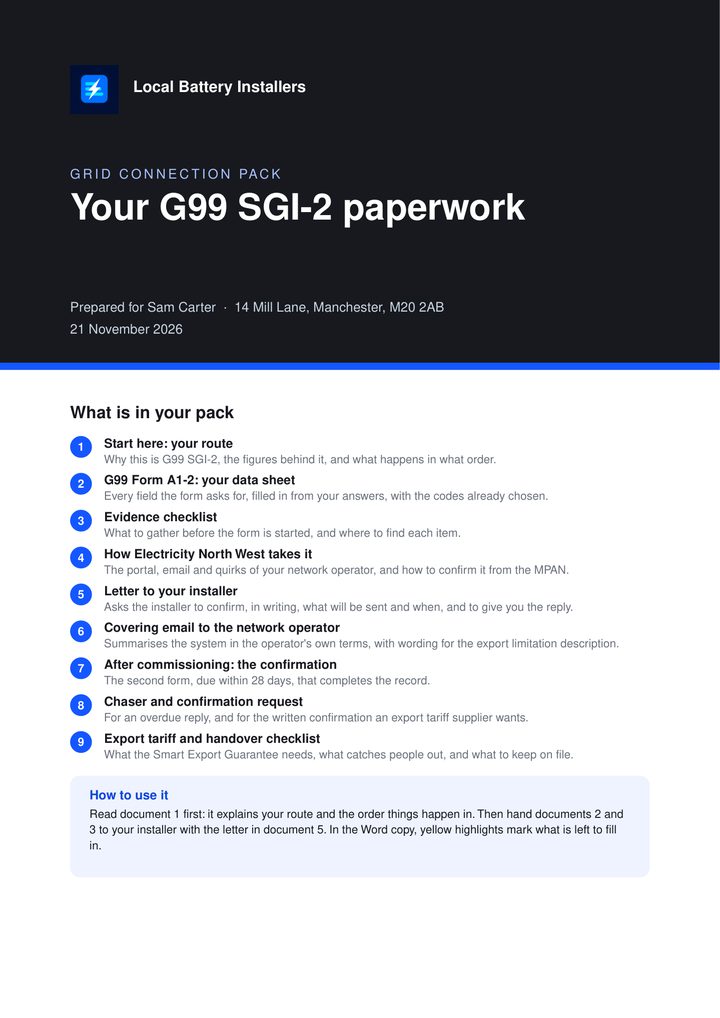
G98 and G99 paperwork
Not sure which form your system needs?
The free route finder works out whether your solar or battery is G98, or G99 SGI-1, SGI-2 or SGI-3, from the inverter sizes. The £19 pack then fills in the form data, the evidence checklist and the letters for your network operator.
Frequently asked questions
Do solar panels need cleaning in the UK?
Not routinely on a pitched roof of 15 degrees or more, because rain does most of the work. Flat or shallow arrays, and panels near farms, roads, the coast, trees or birds, usually benefit from a clean when dirt is visible.
How often should solar panels be cleaned?
Only when you can see dirt or output drops. The Energy Saving Trust suggests checking every 12 to 18 months; Bark's guide suggests every 6 months for coastal, roadside or bird-heavy sites and every 2 to 3 years for steep rural roofs.
How much does solar panel cleaning cost?
Most of the 10 UK sources we read put a home clean at about £60 to £150 a visit. Panels above one storey cost more: Checkatrade puts a 40-panel clean above one storey at £150 to £300.
Do solar panels need servicing?
They need little, but the Energy Saving Trust suggests a full professional service every 3 to 5 years, and some installers make it a warranty condition. Check your warranty papers.
What is the right solar panel cleaner to use?
Plain water, ideally purified or deionised, and a soft brush or sponge. REC allows a mild biodegradable washing-up liquid if rinsed off straight away; none of the three makers allows acid, alkali or abrasive cleaners. Check your own panel manual first.
How much output do dirty solar panels lose?
On a pitched UK roof, usually little, because rain does most of the work. Shallow, coastal, tree-shaded and bird-heavy arrays lose more, which is where a clean can pay: see the worked example above.
Can I use a pressure washer on solar panels?
Avoid it. REC says it will invalidate its warranty and the Energy Saving Trust says power washers can damage seals and wiring. Some manuals allow limited pressure, but only your own maker's manual can tell you.
How do I clean solar panels on my roof?
From the ground only: switch the system off, rinse with a hose and use a soft brush on a long pole early in the morning. Never stand on the panels. If you cannot reach, book a cleaner with a water-fed pole.
Want a real price for your home?
Figures here are a guide. An installer still needs to see your fuse board, where the battery will go and whether you want backup. Tell us your postcode and local installers will quote.
Related guides


Sources
- Energy Saving Trust: how to clean and maintain solar panels (1 Oct 2026; rain usually enough, avoid power washers, clean from £60 to £100, service every 3 to 5 years, inverter 10 to 15 years)
- REC: quick guide to cleaning (no pressure or steam cleaners, warranty conditions, early morning cleaning, deionised water)
- LONGi: PV module operation and maintenance manual, version 02, Jan 2024 (0.7 MPa limit, water rules, cleaning time, low-tilt soiling)
- Aiko: PV modules installation manual (tilt of at least 10 degrees, cleaning methods, 4 MPa limit, warranty)
- E.ON Next: solar panel maintenance and cleaning (15 degree tilt, £100 to £150 for under 20 roof panels)
- Bark: solar panel cleaning cost UK 2026 (£145 average visit, about £9 a panel, 725+ quotes, ex VAT)
- MyJobQuote: solar panel cleaning cost guide (Oct 2026; £150 average, £4 to £15 a panel)
- Checkatrade: solar panel cleaning cost (Aug 2026; £10 to £20 a panel, £150 to £300 above one storey)
- MyBuilder: solar panel maintenance cost (Aug 2026; cleaning £4 to £10 a panel)
- BestBuilders: solar panel cleaning cost (Aug 2026; £60 to £150 a visit, £50 to £100 minimum)
- Heatable: how to clean solar panels (Jul 2026; £5 to £15 a panel)
- Solar Cleaning South West: 2026 price guide (£80 to £140 for 6 to 10 panels)
- Airtasker: solar panel cleaning cost (Jun 2025; about £4 a panel, £50 to £300)
- BSI: BS EN IEC 62446-2, maintenance of grid-connected PV systems
- Electrical Safety First: how often to get the electrics checked in an owner-occupied home
- European Commission JRC: PVGIS 5.3 PV performance calculator