
Quick answer
Tell your home insurer when you fit solar panels. Most buildings policies will cover panels fixed to the roof as part of the structure, but some insurers need to know about the change, may adjust the rebuild cost, or treat the system differently. Insurance covers events such as storm, fire or theft. Equipment faults and poor workmanship are covered by warranties and guarantees instead.
- Tell your insurer about the installation
- Panels are usually covered as part of the buildings
- Insurance covers damage events; warranties cover faults
- Keep receipts, certificates and photos
Do you need to tell your insurer?
Yes. Insurers ask you to report significant changes to a home, and a roof-mounted system is one. Some will include it without changing the premium; others adjust the rebuild cost or add a note to the policy. Not telling them risks a dispute later.
If you have a separate contents policy, ask how an inverter and battery indoors are treated.
What each type of cover protects
Insurance and warranties are often confused. They cover different things.
| Problem | Usually covered by |
|---|---|
| Storm or fallen tree damage | Buildings insurance |
| Fire | Buildings insurance |
| Theft of panels | Buildings insurance, check the policy |
| Panel or inverter fault | Manufacturer warranty |
| Roof leak caused by the installation | Installer workmanship guarantee |
| Installer closes during guarantee | Insurance-backed guarantee, if provided |
Roof leaks and workmanship
If water gets in around roof fixings after installation, the installer's workmanship guarantee should cover the repair. Home insurance often excludes gradual leaks and faulty workmanship. See do solar panels damage your roof.
Ask your installer for an insurance-backed guarantee through their consumer code scheme, so you are protected if the company closes.
Batteries and fire safety
Insurers increasingly ask about home batteries. Tell them where the battery is installed and keep the installation certificate. A battery fitted to the manufacturer's siting rules by a certified installer is easier to insure. See insurance and home batteries.
Keep good records
Store the MCS certificate, electrical certificate, invoices, warranties and a few photos of the installation together. If you claim after a storm, those documents show what was installed and what it cost, and they speed the claim.
Check your monitoring app after severe weather. A sudden drop in generation after a storm can be the first sign that a panel has cracked or a cable has been damaged, even if nothing looks wrong from the ground. Report it to the insurer and the installer promptly, because delays can make it harder to show what caused the damage.
If you rent out the property or let it as a holiday home, tell the insurer about the system and how it is used. Landlord and holiday let policies have their own conditions, and some ask for periodic electrical inspections that include the solar circuit.
Questions to ask your insurer
Ask for the answers by email, so you have them in writing if you ever need to claim.
- Are roof-mounted solar panels covered as part of the buildings, or do they need to be listed?
- Does the rebuild cost need to rise to include the system, and by how much?
- Is the inverter, and any battery, covered as buildings or as contents?
- Is accidental damage to the panels covered, or only named events such as storm and fire?
- Are there conditions about who installed the system or how often it is inspected?
- Is loss of export income covered after an insured event?
Putting a value on the system
Insurers need a realistic replacement cost. Which?, citing the Energy Saving Trust, puts a typical 4.5 kWp system at around £7,600 installed. Use your own invoice where you have one, and add the battery separately.
If a storm takes the system out of action, the lost generation is part of the cost. For a 4 kWp south-facing system in Exeter, PVGIS puts June output at about 480 kWh, so a summer month waiting for a storm repair is a real loss even if the policy does not pay for it.
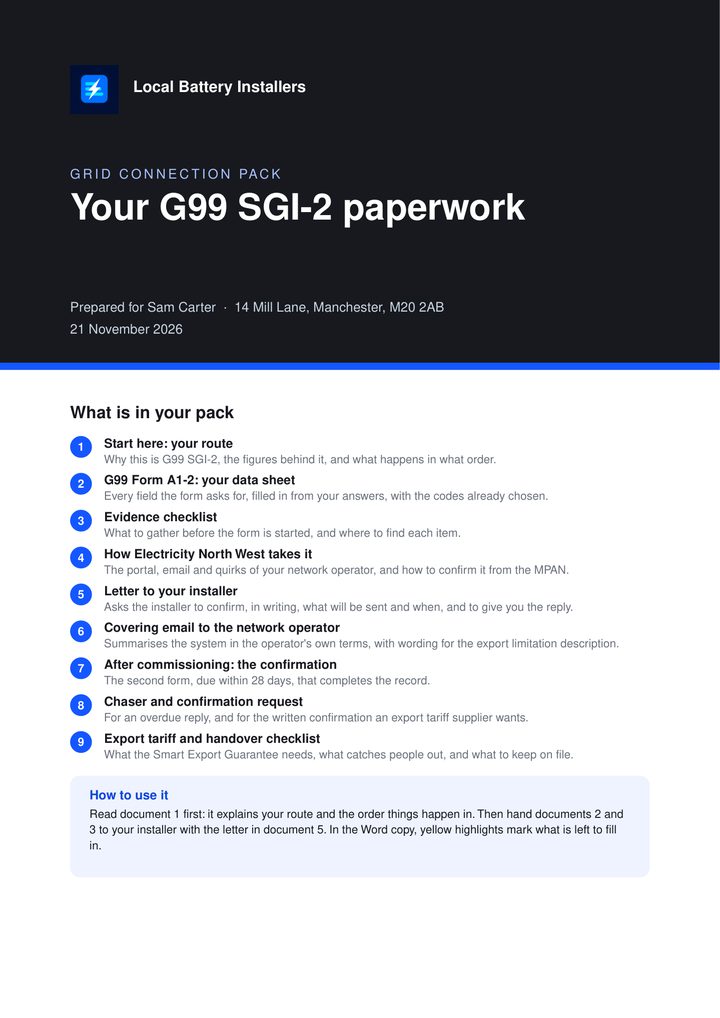
G98 and G99 paperwork
Not sure which form your system needs?
The free route finder works out whether your solar or battery is G98, or G99 SGI-1, SGI-2 or SGI-3, from the inverter sizes. The £19 pack then fills in the form data, the evidence checklist and the letters for your network operator.
Frequently asked questions
Do I need to tell my insurer about solar panels?
Yes. Most will cover them as part of the buildings, but they need to know about the change.
Will solar panels increase my home insurance?
Sometimes slightly, if the rebuild cost rises. Many insurers include them without much change.
Does home insurance cover solar panel faults?
Usually not. Faults are covered by manufacturer warranties; damage events by insurance.
Who pays if the roof leaks after solar is fitted?
The installer, under their workmanship guarantee, if the leak is caused by the installation.
How much is a solar system worth for insurance purposes?
Use your invoice. As a guide, Which? cites the Energy Saving Trust's figure of around £7,600 for a typical 4.5 kWp system installed.
Want a real price for your home?
Figures here are a guide. An installer still needs to see your fuse board, where the battery will go and whether you want backup. Tell us your postcode and local installers will quote.
Related guides


