
Quick answer
There is no solar panel grant that every UK household can claim, but free solar panels are real for lower-income homes: the Warm Homes: Local Grant in England, Nest in Wales and the NISEP Toasty Homes heat pump package in Northern Ireland can fit panels at no cost if you qualify, and Warmer Homes Scotland can include a renewables system. Everyone else pays 0% VAT on installed solar until 31 March 2027, and homeowners anywhere in the UK can borrow up to £15,000 for panels through the government-backed Warm Homes Loan Scheme. ECO4 closes on 31 December 2026 and never listed solar, and the Smart Export Guarantee pays you for exports, not towards the installation. Our solar grant checker applies the rules to your home in six questions.
- No universal solar grant in England, Scotland, Wales or Northern Ireland
- Free solar is for lower-income households, mostly in homes with a poor energy rating
- Warm Homes Loan Scheme: up to £15,000 for solar, homeowners only, 11 lenders listed on GOV.UK
- ECO4 closes on 31 December 2026 and its GOV.UK page does not list solar
- 0% VAT on installed solar until 31 March 2027, then 5%
- Nobody is pre-approved for a grant they did not apply for
Solar funding by nation, checked 26 November 2026
We opened the official page for each scheme on 26 November 2026 and recorded what it says about solar panels today. "Solar?" is our reading of that page, not a promise: the free schemes survey the home first and then decide what to fit, so being eligible does not guarantee panels.
For batteries rather than panels, the picture differs in places, so we keep a separate home battery grants guide with its own table.
| Nation and scheme | Solar? | Who qualifies | Status today |
|---|---|---|---|
| England: Warm Homes: Local Grant | Yes, listed | EPC D to G, income usually £36,000 or less | Open; no end date shown |
| England, Scotland, Wales: ECO4 | Not listed | Certain benefits; insulation and heating | Closes 31 Dec 2026 |
| Wales: Nest | Yes, listed | Benefit or low income; EPC E or below | Open |
| Scotland: Warmer Homes Scotland | "Home renewables system" | 75 or over with no working heating, terminal illness or passport benefit | Open |
| Scotland: Home Energy Scotland Grant and Loan | PV-T loan only, £5,000 | Homeowners; no grant for solar | Open |
| Northern Ireland: NISEP Toasty Homes | Yes, fully funded | Owner occupiers under £28,000 (single) or £35,000 (couple) | To 31 Mar 2027 or funds run out |
| Northern Ireland: NISEP Priority PV | Free to tenant (50% NISEP, rest NIHE) | NIHE tenants, single-storey, off gas, oil or electric heating | To 31 Mar 2027 or funds run out |
| UK: Warm Homes Loan Scheme | Loan, up to £15,000 | Homeowners passing lender checks | Open; 11 lenders listed |
| UK: 0% VAT | Yes, on fitted solar | All homes | To 31 Mar 2027, then 5% |
England: the Local Grant, ECO4 and what comes next
The Warm Homes: Local Grant is the main free route to solar in England. The GOV.UK page lists wall, loft and underfloor insulation, air source heat pumps, smart controls and solar panels. The home must be privately owned, by you or a landlord, with an EPC of D, E, F or G, and household income must usually be £36,000 a year or less, although a listed postcode or certain benefits can qualify you above that. You check eligibility with the Home Energy Advice service on 0800 098 7950, apply with a GOV.UK One Login, and your council arranges and pays for the agreed work. A landlord may have to pay for some improvements.
ECO4, the Energy Company Obligation, is closing on 31 December 2026, according to its GOV.UK page. That page lists insulation and boiler or heating upgrades and does not mention solar panels. Starting an ECO application this late is unlikely to end with panels on your roof.
The Warm Homes Plan, published on 21 January 2026, says the government intends to combine the Local Grant and the Warm Homes: Social Housing Fund into a single low-income scheme from 2027/28, and names solar PV and batteries among the measures it expects to support. No application route for that scheme was on GOV.UK when we checked. At the Budget on 29 October 2026, pv magazine reported that grant support for home solar, batteries and heat pumps would continue through the plan.
Wales, Scotland and Northern Ireland
Wales: Nest is free and its GOV.WALES page lists heat pumps, insulation and solar panels. You must own or privately rent (not council or housing association), and either get a means-tested benefit such as Universal Credit or Pension Credit, or fall under the income limits measured after housing costs, for example £15,521 a year for a single adult or £32,433 for a couple with two children under 14. The home must score 54 (E) or less, or 68 (D) or less where someone has an eligible health condition. Nest's number is 0808 808 2244.
Scotland: Warmer Homes Scotland, delivered by Warmworks, says the Scottish Government meets all the costs in most cases and can install "a home renewables system". It does not say solar panels by name, so ask at the survey. The Home Energy Scotland Grant and Loan is open to any homeowner but, on today's funding table, the only solar item is a £5,000 loan for hybrid PV-T panels, with no grant. Home Energy Scotland's freephone line is 0808 808 2282.
Northern Ireland: the nidirect page still says there is no financial support for homeowners who want to generate their own electricity. The Utility Regulator's NISEP list for April 2026 to March 2027 goes further. Its Toasty Homes Heat Pump and Solar Technologies scheme is a fully funded package for owner occupiers under the income limits (gross income under £28,000 for a single person or £35,000 for a couple or family) whose home is replacing or upgrading its heating: no central heating, solid fuel, an oil or LPG boiler over 15 years old or broken, or older storage heaters. The package is led by an air source heat pump, with photovoltaic panels, battery storage and insulation alongside, so it is not a route to solar panels on their own. The scheme manager is McGaffin Mechanical on 028 9099 6747. A separate Priority PV scheme covers Housing Executive tenants only, in single-storey homes outside the natural gas area with oil or electric heating, under the same income limits: NISEP pays 50% of a PV system, hybrid inverter and battery and the Housing Executive pays the rest, so the tenant pays nothing. The Housing Executive chooses the homes. NISEP funds are limited and the year ends on 31 March 2027.
Free solar panels: what is real
"Free solar panels" and "funded solar panels" are real phrases for a narrow group: households on lower incomes or qualifying benefits, usually in a home with a poor energy rating, who go through one of the schemes above. If your household earns well above £36,000 in England, lives in an EPC C home, or rents from a council in Wales, the free routes are unlikely to apply.
How you get in also tells you a lot. For the Local Grant you start the process yourself with Home Energy Advice and GOV.UK. Nest and Home Energy Scotland start with a free phone call to their own numbers. Under ECO, GOV.UK says installers or agents may contact you directly, and that if you are unsure whether an offer is genuine you should check with your council or the energy supplier the caller says they represent. That door-knocking model is exactly what scammers copy, and it ends on 31 December 2026 anyway.
A National Audit Office report from 14 October 2025 quotes an Ofgem estimate that firms submitted false ECO claims for between 5,600 and 16,500 homes. That is a good reason to verify any installer who found you, rather than the other way round.
Scam check before you agree to anything
Run through these before you sign, pay or let anyone survey your roof. They come from Citizens Advice, the GOV.UK scheme pages and the MCS, TrustMark and RECC registers.
- Unexpected caller: Citizens Advice says hang up, wait 5 minutes for the line to clear, then call the organisation back on a number from its official website.
- "Government-backed" claims: the Warm Homes Loan Scheme really is government-backed, but the money comes from a lender. Check the lender is on the GOV.UK list of 11 (from HomeServe Finance to Zopa) before you share details.
- A fee to check eligibility or release a grant: under the Local Grant your council pays for the agreed work, and the GOV.UK page says you will not need to pay for it.
- Pressure to pay now, or to pay in an unusual way: Citizens Advice lists both as warning signs.
- MCS: search the installer by name or certificate number on the MCS Find an Installer tool, for solar specifically. Warm Homes loans need an MCS-certified installer.
- TrustMark: it describes itself as the government endorsed quality scheme. Check the firm is registered for the trade you need, not just any trade.
- RECC: the Renewable Energy Consumer Code forbids its members from unfair selling tactics. Its member directory searches by name, postcode and technology.
- Report a scam to Report Fraud on 0300 123 2040, and suspected misuse of the loan scheme to WHLScounterfraud@energysecurity.gov.uk.
The Warm Homes Loan Scheme, for everyone else
If you own your home and do not qualify for free panels, this is the main government help. The GOV.UK factsheet of 27 October 2026 says loans can cover up to £15,000 for solar panels and £15,000 for a battery, that lenders offer up to 5 per cent lower interest than a regular loan, that some loans are interest free, and that some run for up to 30 years. It covers England, Scotland, Wales and Northern Ireland.
GOV.UK's eligibility page says you must own the property, with or without a mortgage, it must be residential, and an MCS-certified installer must do the work, so no DIY. Some lenders only work with their own installers. GOV.UK's scheme page says you cannot use a Warm Homes loan and other government funding to pay for the same improvement, but that you may be able to use the loan alongside the Boiler Upgrade Scheme and Home Energy Scotland grants. The factsheet's own advice is to look at the total amount repayable, not the monthly figure. A loan is still debt: see how to compare solar panel quotes before you choose an installer or a lender.
0% VAT: worked out on our planning range
HMRC's VAT Notice 708/6 zero-rates the installation of energy-saving materials, including solar panels, from 1 May 2023 to 31 March 2027, in residential accommodation. From 1 April 2027 the notice says the rate reverts to 5%. Panels bought without installation are standard-rated, so a supply-only kit does not qualify. You do not apply: check that the quote shows 0% on the installation.
Our own planning range for a typical 4 kWp system is £6,000 to £7,500 fitted at 0% VAT. These are our planning figures, not a shop price. At 5% the same job would be £6,300 to £7,875, so the change on 1 April 2027 adds about £300 to £375. That is smaller than the gap you often see between two quotes for the same specification, so do not let the deadline rush you. More detail in tax on solar panels.
| VAT rate | Low end | High end |
|---|---|---|
| 0% (to 31 March 2027) | £6,000 | £7,500 |
| 5% (from 1 April 2027) | £6,300 | £7,875 |
| Difference | £300 | £375 |
Things that are not solar grants
The Smart Export Guarantee pays you for electricity you export, through a licensed supplier you choose, and Ofgem says installations must be in Great Britain, so it does not apply in Northern Ireland. MCS says your system must be installed by an MCS-certified installer and you need a smart meter that records exports. It is income after the panels are up, not money towards buying them. See the SEG and batteries.
The Boiler Upgrade Scheme helps replace fossil fuel heating with a heat pump or biomass boiler in England and Wales. Solar panels are not part of it. See the Boiler Upgrade Scheme is not a battery grant. Solar subscriptions and council group-buying schemes such as Solar Together can lower or spread the cost, but you still pay.
If you do not qualify
Most households pay for solar themselves. Get two or three MCS-certified quotes on the same panel count, inverter and scaffolding, use the solar panel calculator to see what the system could save, and read what solar panels cost. You can request quotes from local installers through us. We have not tested any scheme, lender or installer named here, and only the scheme itself can confirm what you will get.
G98 and G99 paperwork
Not sure which form your system needs?
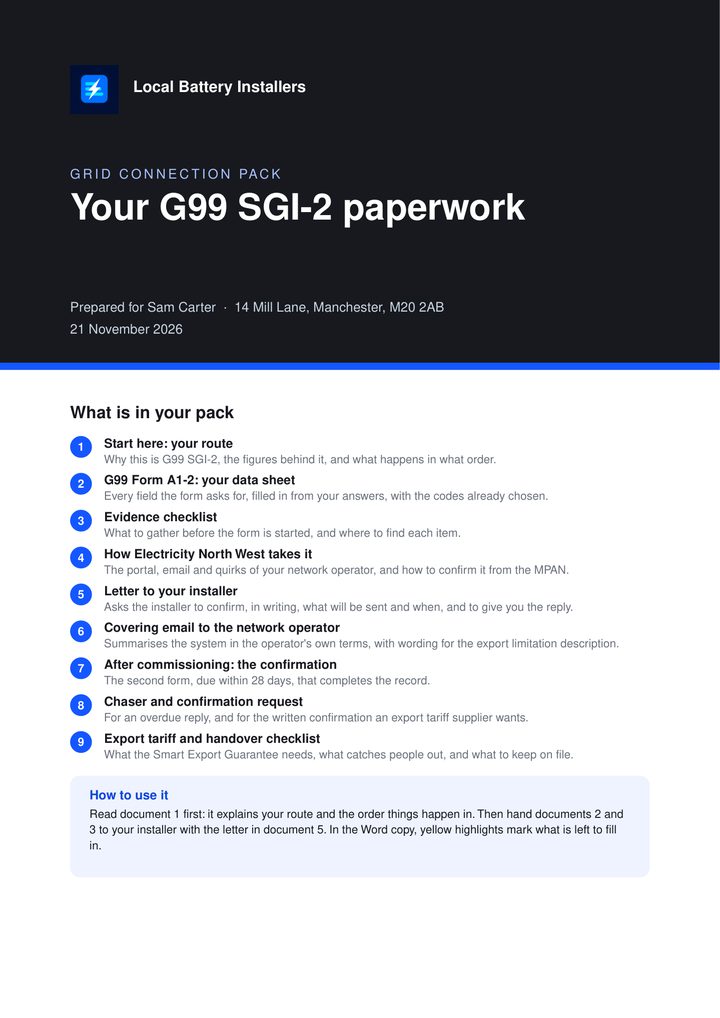
The free route finder works out whether your solar or battery is G98, or G99 SGI-1, SGI-2 or SGI-3, from the inverter sizes. The £19 pack then fills in the form data, the evidence checklist and the letters for your network operator.
Frequently asked questions
Are there government grants for solar panels in the UK?
Not for everyone. Lower-income households can get panels fitted free through the Warm Homes: Local Grant in England, Nest in Wales or NISEP Toasty Homes in Northern Ireland, and Warmer Homes Scotland can include renewables. Everyone gets 0% VAT until 31 March 2027, and homeowners can borrow up to £15,000 through the Warm Homes Loan Scheme.
Can I get free solar panels?
Only if you qualify for one of the income-based schemes, which usually also look at the home's energy rating. In England that is the Local Grant, with income usually £36,000 or less and an EPC of D to G. Offers of free solar for everyone are not a scheme.
Is ECO4 still open for solar panels?
ECO closes on 31 December 2026. Its GOV.UK page lists insulation and heating upgrades and does not mention solar panels, so it is not a realistic route to panels now.
Is there a new solar grant in 2026?
The new help in 2026 is the Warm Homes Loan Scheme, a loan rather than a grant, set out in a GOV.UK factsheet on 27 October 2026. The Warm Homes Plan says a combined low-income scheme covering solar PV and batteries is intended from 2027/28, but no application route had been published when we checked.
Are there solar grants in Northern Ireland?
For some households. nidirect says there is no general support, but the NISEP list for 2026 to 2027 includes Toasty Homes, a fully funded heating package led by an air source heat pump that can include PV and battery storage for qualifying owner occupiers, and Priority PV, which is free to Housing Executive tenants in single-storey homes outside the gas area with oil or electric heating (50% NISEP, the rest paid by the Housing Executive).
Can I get a government loan for solar panels?
Yes. The Warm Homes Loan Scheme lends up to £15,000 for solar panels through participating lenders, and GOV.UK lists 11 of them. You must own the home, use an MCS-certified installer and pass the lender's credit and affordability checks.
Can pensioners get free solar panels?
There is no age-based solar grant. Pension Credit counts as a qualifying benefit for Nest and Warmer Homes Scotland, and NISEP income limits include pension income. In England the Local Grant looks at household income and the EPC, not age.
Is the Smart Export Guarantee a grant?
No. It pays you for electricity you export once your panels are working. It does not pay towards the cost of installing them, and it does not apply in Northern Ireland.
Want a real price for your home?
Figures here are a guide. An installer still needs to see your fuse board, where the battery will go and whether you want backup. Tell us your postcode and local installers will quote.
Related guides


Sources
- GOV.UK: Apply for the Warm Homes: Local Grant
- GOV.UK: Energy Company Obligation
- DESNZ: Warm Homes Plan, January 2026
- GOV.UK: Warm Homes Loan Scheme factsheet, 27 October 2026
- GOV.UK: Warm Homes Loan Scheme
- GOV.UK: Warm Homes Loan Scheme eligibility
- GOV.UK: Lenders offering Warm Homes loans
- GOV.UK: Warm Homes Loan Scheme help and fraud reporting
- HMRC: VAT Notice 708/6, energy-saving materials and heating equipment
- Welsh Government: Nest eligibility
- Welsh Government: Get help with energy efficiency from Nest
- Home Energy Scotland: Grant and Loan
- Home Energy Scotland: Warmer Homes Scotland
- nidirect: support to generate your own electricity
- Utility Regulator: NISEP list of schemes, April 2026 to March 2027
- Ofgem: Smart Export Guarantee
- MCS: Smart Export Guarantee for consumers
- MCS: Find an installer
- GOV.UK: Boiler Upgrade Scheme
- Citizens Advice: check if something might be a scam
- Citizens Advice: reporting a scam
- TrustMark
- Renewable Energy Consumer Code: for consumers
- National Audit Office: faulty installations under energy efficiency schemes, 14 October 2025
- pv magazine: UK Budget, 29 October 2026