
Quick answer
Ground-mounted solar panels sit on a frame in the garden or a field instead of the roof. They suit homes with a shaded, north-facing or fragile roof and plenty of open land. They can be angled and oriented perfectly, so each panel often produces a little more than on a roof. They need a buried cable run back to the house and must meet permitted development limits on size, height and distance from the boundary.
- Good where the roof is shaded, north-facing or fragile
- Perfect angle and orientation, easy to clean
- Costs more for frames, groundwork and cabling
- Planning limits apply to size, height and boundary distance
When ground-mount beats the roof
A roof is usually the cheapest place for panels, because the structure is already there. Ground mounting wins where the roof faces north, is heavily shaded, is too small, is listed or is near the end of its life.
Rural homes with open land use ground arrays most, because they have space away from shade and the cable run is manageable.
Think about the view and the neighbours too. A ground array is more visible than one on a roof, and it takes up garden space for 25 years or more. A position at the back of the plot, screened by planting that will not grow tall enough to shade it, usually keeps everyone happy. Leave room to walk round the frame for cleaning and inspection.
Cost compared with roof panels
The panels and inverter cost the same. The extra cost comes from frames, foundations, trenching and the cable run back to the house. A longer run needs thicker cable to limit losses.
| Item | Why it costs more |
|---|---|
| Frames | Galvanised or aluminium structures with ground screws or concrete |
| Trenching | Cable must be buried at a safe depth and recorded |
| Cable | Longer runs need larger cable sizes |
| Fencing or protection | Sometimes needed from livestock or children |
| Scaffolding saved | No roof scaffold, which offsets some cost |
Planning limits
In England, a standalone solar array in a house's garden is permitted development only if the panels total no more than 9 square metres. It must also be no taller than 4 metres, or 2 metres within 5 metres of the boundary, and 1 metre if it is also in front of the house. Larger arrays need planning permission. Conservation areas and listed buildings add further restrictions.
Run your plans through the solar planning checker and read solar panels and planning permission.
Output and upkeep
Because a ground frame can face due south at an ideal tilt with air behind it, each panel often generates slightly more than one on a typical roof. Panels are easy to reach for cleaning and inspection.
Keep grass and plants trimmed so they do not shade the lower edge, and check the frame and fixings each year. See solar panel cleaning and maintenance.
Adding a battery
A battery usually goes in the house or a garage near the consumer unit, not in the field. The installer designs the DC or AC cabling to suit. See adding a battery to existing solar and get quotes.
The 9 square metre limit in practice
Nine square metres sounds generous until you count panels. REC lists its 400 to 430 W panels at about 1.93 m² each, so the limit allows four of them: roughly 1.6 to 1.7 kWp. That is a useful top-up, but most households want 4 kWp or more.
So for most ground arrays, plan on a householder planning application. Councils often approve arrays that are low, screened and set back from neighbours, but it adds weeks to the timeline.
How much more a ground array makes
Take a farmhouse outside Hereford whose only large roof faces north. In PVGIS, a free-standing 4 kWp array facing south at 38 degrees in the paddock makes about 4,000 kWh a year. The same panels on a south roof at 35 degrees would make about 3,870 kWh, so the ground array gains a few per cent from cooler panels and an ideal angle.
The bigger gain comes when the alternative roof is poor. That farmhouse's north-facing roof at 35 degrees would make only about 2,130 kWh a year in the same model, so moving the panels into the paddock nearly doubles their output.
| Position | kWh a year |
|---|---|
| Ground frame, south at 38 degrees | About 4,000 |
| South roof at 35 degrees | About 3,870 |
| East roof at 35 degrees | About 3,110 |
| North roof at 35 degrees | About 2,130 |
G98 and G99 paperwork
Not sure which form your system needs?
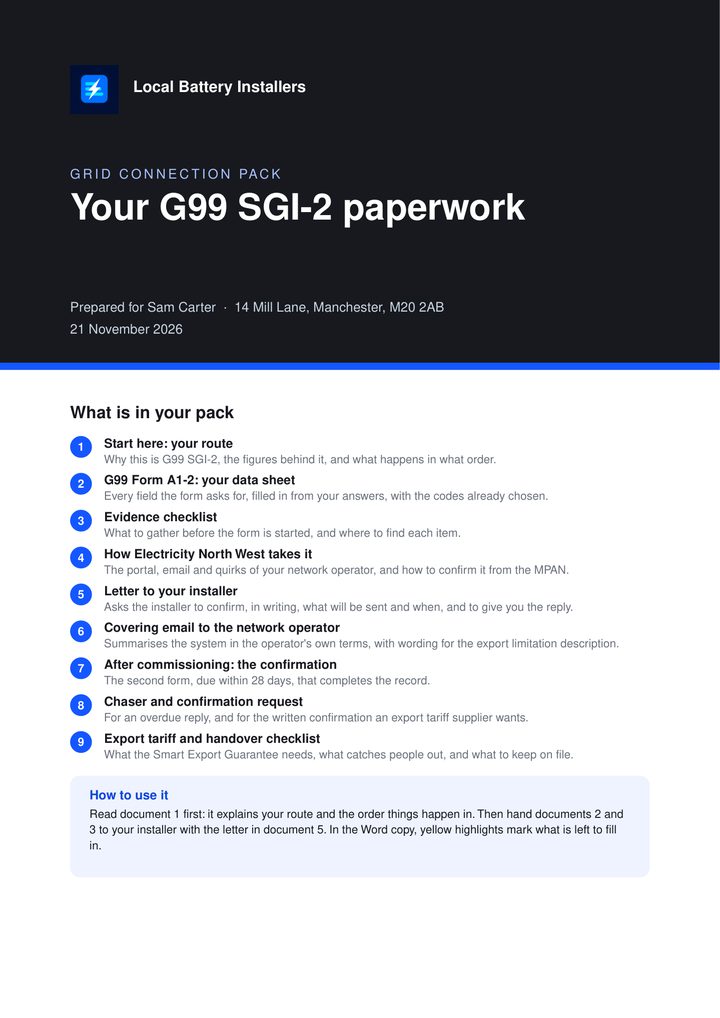
The free route finder works out whether your solar or battery is G98, or G99 SGI-1, SGI-2 or SGI-3, from the inverter sizes. The £19 pack then fills in the form data, the evidence checklist and the letters for your network operator.
Frequently asked questions
Are ground-mounted solar panels worth it?
Yes where the roof is unsuitable and there is open space. They cost more to install but often generate slightly more per panel.
Do ground-mounted solar panels need planning permission?
Only small ones. In England the panels must total no more than 9 m², about four modern panels, to be permitted development. A typical 4 kWp array needs planning permission.
How far can ground panels be from the house?
Distance mainly affects cable cost and losses. Long runs need larger cable.
Is a ground frame a good choice for a thatched house?
It can be, because nothing is fixed to the thatch. See solar panels on a thatched roof.
Can ground-mounted panels get the SEG?
Yes, if the installation is MCS certified.
How many panels can I put in my garden without planning permission?
In England, panels totalling no more than 9 m². With modern panels of about 1.93 m², that is four panels, or roughly 1.6 to 1.7 kWp.
Want a real price for your home?
Figures here are a guide. An installer still needs to see your fuse board, where the battery will go and whether you want backup. Tell us your postcode and local installers will quote.
Related guides


