
Quick answer
Most solar panels on a house roof in England are permitted development and need no planning application, provided they do not stick out more than 0.2 metres from a pitched roof slope or rise above the highest part of the roof. Flat roofs have their own limits. The same roof limits cover blocks of flats unless the block is listed, a listed house or block needs planning permission and listed building consent since 27 August 2026, and conservation areas restrict panels on walls facing a road. Scotland, Wales and Northern Ireland have similar but separate rules.
- Most house roofs in England: permitted development
- Pitched roof: no more than 0.2 m proud of the slope, not above the ridge
- Listed buildings need planning permission and listed building consent; blocks of flats are covered too, unless listed
- Ground-mounted arrays have size and boundary limits
Permitted development for house roofs
Class A of Part 14 of the General Permitted Development Order lets you fit solar panels on a house or its outbuildings without a planning application, within limits. Panels on a pitched roof must not protrude more than 0.2 metres beyond the roof slope and must not be higher than the highest part of the roof, excluding the chimney.
Panels should be sited, as far as practical, to minimise their effect on the look of the building and the area. Most normal installations meet these limits without any trouble. Run your own answers through the solar planning permission checker.
Flat roofs, walls and ground arrays
Flat roofs are allowed under permitted development in England, but the highest part of the panels and frames must not sit more than 0.6 metres above the highest part of the roof, excluding any chimney. On some protected land, such as conservation areas, a flat-roof array needs a prior approval application to the council about its appearance before work starts.
Ground-mounted panels at a house come under Class B of the same Part, which limits the panel area to 9 m² and sets height limits that tighten near the boundary and in front of the house. If you want a large garden array, ask the council or apply for a lawful development certificate first.
| Situation | Usually need permission? |
|---|---|
| Pitched roof of a house, within limits | No |
| Flat roof of a house, within height and edge limits | No |
| Listed building | Yes, planning permission and listed building consent |
| Conservation area, wall facing a highway | Yes |
| Block of flats, within the roof limits | No (unless listed), but you need the freeholder's consent |
| Ground array within size and boundary limits | No |
| Large ground array or close to the boundary | Yes |
Listed buildings, conservation areas and flats
Since 27 August 2026, when the Town and Country Planning (General Permitted Development) (England) (Amendment) Order 2026 took effect, solar on a listed house is outside permitted development, so it needs planning permission as well as listed building consent. Councils often accept panels on rear or hidden roof slopes and refuse prominent front slopes.
In a conservation area, roof panels are often still permitted development, but panels on walls fronting a highway are not. Blocks of flats have been covered by Class A since 2015, with the same 0.2 metre and ridge limits on pitched roofs and 0.6 metres on flat roofs. Since the 2026 order, a listed block is excluded. A flat owner still needs the freeholder's agreement under the lease, and the order also now covers plug-in solar, except on timber walls, balconies or cladding: see plug-in solar panels in the UK.
Building regulations and the network
Planning is separate from building regulations. The roof must carry the extra load, and the electrical work must be certified. A certified installer handles both and notifies building control through their scheme.
Your network operator must also be told. Systems up to 3.68 kW per phase are usually notified after installation; larger systems need approval first. See G98 and G99 and the DNO lookup tool. For batteries, see planning permission for home batteries.
The numbers in the rules, in one place
These limits come from Part 14 of the General Permitted Development Order for England, as amended up to 2026. They apply to houses. Flats, listed buildings and scheduled monuments have tighter rules.
| Where the panels go | Limit in the order |
|---|---|
| Pitched roof | No more than 0.2 m proud of the roof slope, and no higher than the highest part of the roof, excluding chimneys |
| Flat roof | Highest part no more than 0.6 m above the highest part of the roof, excluding chimneys |
| Wall facing a highway | No more than 0.2 m proud of the wall; not allowed in a conservation area |
| Other walls | No more than 0.4 m proud of the wall |
| Standalone array in the garden | Panel area no more than 9 m², height no more than 4 m, or 2 m within 5 m of the boundary |
| Standalone array in front of the house and within 5 m of the boundary | Height no more than 1 m |
| Standalone array in a conservation area, nearer a road than the house | Height no more than 2 m |
What 9 square metres means in practice
The 9 m² limit for a garden array catches people out. A modern 400 to 430 W panel measures about 1.93 m², going by REC's published data, so 9 m² holds only four of them: about 1.6 to 1.7 kWp.
A typical 4 kWp home system on the ground needs planning permission, even though the same panels on the house roof usually would not. See ground-mounted solar panels.
G98 and G99 paperwork
Not sure which form your system needs?
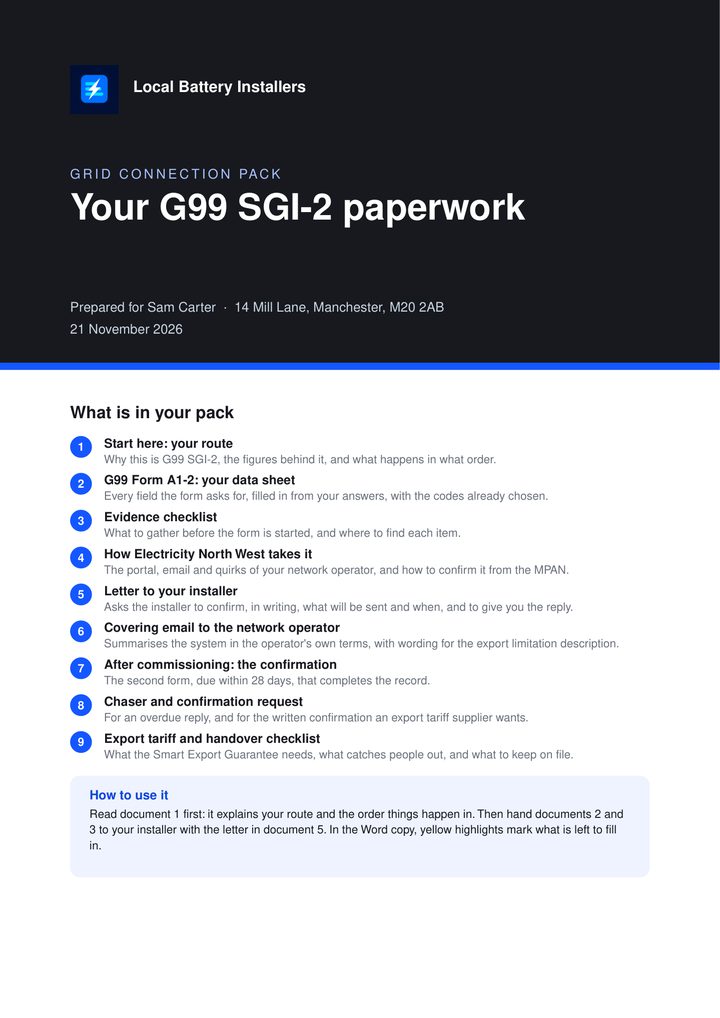
The free route finder works out whether your solar or battery is G98, or G99 SGI-1, SGI-2 or SGI-3, from the inverter sizes. The £19 pack then fills in the form data, the evidence checklist and the letters for your network operator.
Frequently asked questions
Do I need planning permission for solar panels on my house?
Usually not in England, if the panels sit within 0.2 m of a pitched roof slope and do not rise above the highest part of the roof.
Can I put solar panels on a listed building?
In England you need planning permission and listed building consent, since panels on a listed house have been outside permitted development from 27 August 2026. Rear or hidden roof slopes are more likely to be approved.
Do flats need planning permission for solar panels?
Usually not in England, within the same roof limits, unless the block is listed. You still need the freeholder's consent.
Can I get confirmation that I do not need permission?
Yes. A lawful development certificate from the council confirms that a proposal is permitted development.
How high can solar panels be on a flat roof?
In England, the highest part of the panels and frames must not be more than 0.6 metres above the highest part of the roof, excluding chimneys, to count as permitted development.
Want a real price for your home?
Figures here are a guide. An installer still needs to see your fuse board, where the battery will go and whether you want backup. Tell us your postcode and local installers will quote.
Related guides


