
Quick answer
There is no UK rule that bans solar panels on thatch, but there is also no government test of them on thatch, and that gap is the whole problem. The Building Safety Regulator's fire experiments in 2025 used tiled pitched roofs and found that every roof with panels spread flames further than the control roof. Fire services say thatch fires spread rapidly and are very hard to put out. So treat a thatched roof as a last resort for panels: ask your insurer in writing first, and price an outbuilding or ground-mounted array alongside it.
- No ban, but no published fire test of panels fixed to thatch either
- Government tests on tiled roofs found panels increased flame spread
- Fire services say thatch fires spread fast and are very hard to extinguish
- A listed thatched house needs listed building consent for panels
- A tiled garage, barn or ground frame can take the panels instead
What the evidence covers, and what it does not
The best recent UK evidence is a set of 11 large-scale fire experiments done at the Health and Safety Executive's science centre for the Building Safety Regulator. They tested panels over pitched roofs with concrete tiles and one with plastic tiles, and the regulator published a summary in December 2025 with the warning that findings may change when the full report is finished.
The summary says all samples with panels had more flame spread than the control sample, because the gap under a panel lets flames climb higher. Panels with a plastic back sheet spread fire much further up the array than glass-backed ones, and roof-integrated systems with wooden battens and plastic trays were harder to extinguish because part of the fire sat in a sealed cavity.
None of those tests used thatch. That cuts both ways. It does not show panels on thatch are unsafe, and it gives no reassurance that they are safe. Anyone who tells you it is simply fine has no UK test result to point to.
Why thatch raises the stakes
Devon and Somerset Fire and Rescue Service says thatch fires spread rapidly and are very difficult to put out, and that nearly a quarter of the thatched property fires it attended saw the whole building damaged. Most start in the chimney, but badly installed electricity cables are listed as another cause.
That second point matters for solar. A panel array adds direct current cables, isolators and an inverter, and cable runs through a thatched roof void are exactly the kind of work a thatch specialist and your insurer will want to see designed in advance. Direct current cabling on a roof is not something to leave to a first-day site decision.
- Thatch cannot be fixed to the way a tiled roof is, so the mounting method needs a written design, not a standard hook-and-rail kit
- Cable routes through the thatch and roof void are a fire risk in their own right
- A fire in the panel or inverter area would be next to the most flammable roof covering there is
- Fire crews cannot easily get water behind sealed panels, as the government tests showed for integrated systems
Planning: ordinary house or listed building?
In England, solar panels on a house are normally permitted development under Part 14, Class A of the General Permitted Development Order. The panels must not stick out more than 0.2 metres from the roof slope and must not rise above the highest part of the roof, excluding the chimney. In a conservation area they cannot go on a wall facing a highway.
The same Class A says development is not permitted on a dwellinghouse that is a listed building, or on a building in the curtilage of one. Many thatched homes are listed, so check the National Heritage List for England before you ask for a quote. If it is listed, you need listed building consent, and the application has to explain how the thatch, the fire risk and the appearance are handled. The solar planning checker covers the ordinary rules, and solar panels and planning permission explains them. Scotland, Wales and Northern Ireland have their own rules.
What to ask before you pay for anything
Do these in order. The first one can end the idea before you spend any money.
- Ask your buildings insurer, by email, whether they will cover a thatched house with roof-mounted panels, and keep the reply. Some insurers of thatched homes may refuse, load the premium or set conditions. See solar panels and home insurance
- Ask the installer for a written method statement for fixing to thatch, the cable route and where the inverter and isolator will sit
- Ask whether the panels are glass-backed or plastic-backed, since the government tests found much less fire spread on glass-backed panels
- Ask your local fire and rescue service if it has thatch guidance and whether it will comment on the design
- Ask your thatcher how the fixings affect the thatch life, rethatching and the warranty on the thatch itself
Three ways to get solar without fixing to the thatch
Most of the value of solar comes from the sun and the roof angle, not from the thatch, so look at what else on the plot can take panels. A slated or tiled outbuilding is often the best candidate; see solar panels on a slate roof for how slate is fixed without breakage.
| Option | What it needs | Watch for |
|---|---|---|
| Panels on a tiled or slated outbuilding | A garage, barn or annexe with a sound, sun-facing roof | A cable run back to the house consumer unit, and a separate roof structure check |
| Ground-mounted frame in the garden | Open, unshaded space with a trench route to the house | Permitted development limits for stand-alone solar, so check them first. See [ground-mounted solar panels](/guides/ground-mounted-solar-panels-uk/) |
| Battery only, charged on a cheap tariff | A safe, non-thatch location for the unit, such as a garage or outbuilding wall | Savings come from tariff gaps, not free sun. Use the [battery size tool](/tools/battery-size/) |
Where a battery should and should not go
Keep a battery out of the thatched roof void and away from the thatch itself. A wall inside a garage, utility room or outbuilding is the usual choice, with the cable route and isolator position agreed in writing. Our guide to G98 and G99 for home batteries covers the network paperwork for any export-capable system.
We have not tested any panel, mount or battery on thatch, and nothing here is fire engineering advice. For a thatched home, the insurer, the thatcher and the fire and rescue service are the people whose written answers count.
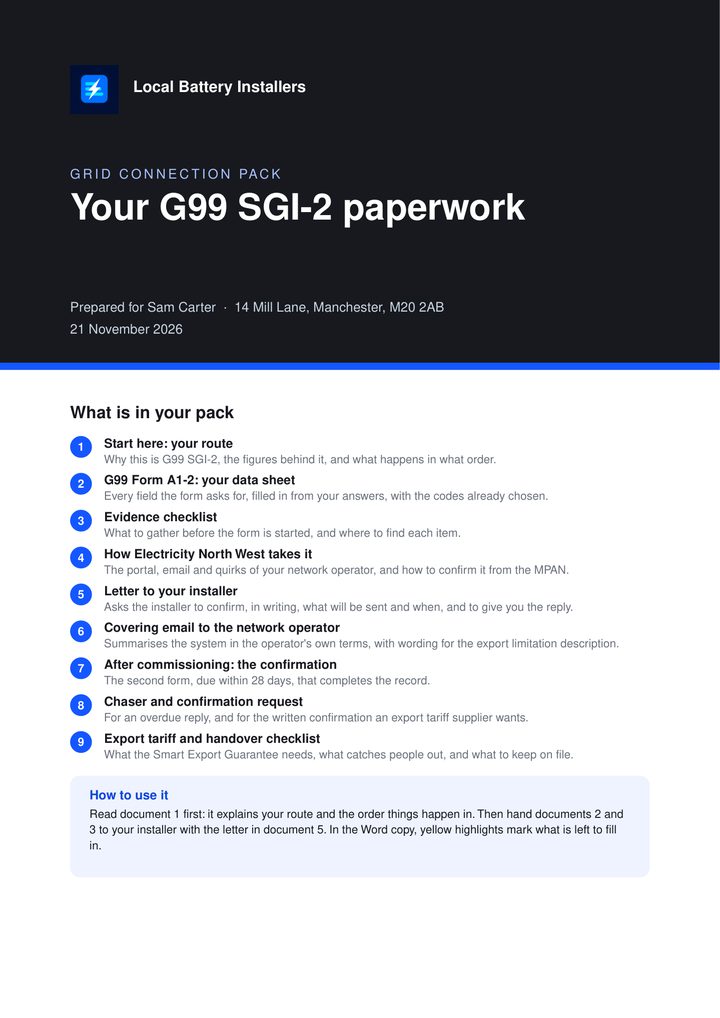
G98 and G99 paperwork
Not sure which form your system needs?
The free route finder works out whether your solar or battery is G98, or G99 SGI-1, SGI-2 or SGI-3, from the inverter sizes. The £19 pack then fills in the form data, the evidence checklist and the letters for your network operator.
Frequently asked questions
Can you put solar panels on a thatched roof?
There is no UK ban, but there is no published fire test of panels on thatch and the practical barriers are insurance, fixing methods and fire risk. Many owners choose an outbuilding or ground-mounted array instead.
Do solar panels on thatch need planning permission?
In England, panels on an unlisted house are normally permitted development if they stay within the Class A limits. A listed thatched house needs listed building consent, and conservation areas have extra limits on walls facing a road.
Will my insurer cover a thatched house with solar panels?
Ask before you commit. Insurers of thatched homes set their own terms, so get their answer in writing, including any change to the premium or conditions.
Are solar panels a fire risk?
The Building Safety Regulator's 2025 experiments on tiled roofs found that panels increased flame spread compared with a roof without them, and that glass-backed panels spread less than plastic-backed ones. The risk of an ignition starting in a well-installed system is a separate question.
Can I put solar panels on a garage instead of my thatched house?
Often yes, if the garage roof is sound and faces the sun. You will need a cable run to the house and a structural check, and in England the same permitted development rules apply to buildings in the curtilage of an unlisted house.
Want a real price for your home?
Figures here are a guide. An installer still needs to see your fuse board, where the battery will go and whether you want backup. Tell us your postcode and local installers will quote.
Related guides


Sources
- GOV.UK (Building Safety Regulator): fire spread over pitched roofs fitted with solar panels, summary
- Devon and Somerset Fire and Rescue Service: thatched properties
- UK legislation: GPDO Schedule 2, Part 14
- Planning Portal: solar panels
- Energy Saving Trust: solar panels
- MCS Certified
- Renewable Energy Consumer Code (RECC)