
Quick answer
In England, new Building Regulations published on GOV.UK on 24 March 2026 add a requirement for on-site renewable electricity generation on new homes, which in most cases means solar panels. The rules come into force on 24 March 2027, but homes registered with building control before then and started before 24 March 2028 can still be built to the old rules. If you are buying a new build, ask for the system size, inverter model, MCS certificate, DNO notification and handover pack before you complete.
- The new requirement (Part L, requirement L3) applies in England from 24 March 2027, with a transition that can run to 24 March 2028 for each building.
- GOV.UK guidance sizes the system against a reference array: 0.22 kWp per square metre over 40% of the house's ground floor area.
- Wales has its own rules, in force from 4 March 2027. For Scotland and Northern Ireland, check your local building standards.
- You need the MCS certificate (or equivalent) and a half-hourly export meter with an export MPAN to get Smart Export Guarantee payments.
- A battery is not required by the new rules, but can usually be added later with its own inverter or through a battery-ready hybrid inverter.
What the new rules require
The government's Building Circular 01/2026, published on GOV.UK on 24 March 2026, introduces The Building Regulations etc. (Amendment) (England) Regulations 2026. GOV.UK calls the package the Future Homes and Buildings Standards. It adds a new functional requirement, L3, for a system of on-site renewable electricity generation when a new dwelling, or a building containing dwellings, is put up. The government's June 2025 announcement said it expected this to be solar panels in the vast majority of cases.
The detail sits in Approved Document L 2026, Volume 1: Dwellings. Revised versions of both volumes, and an FAQ page, were added on 8 September 2026. The GOV.UK frequently asked questions page explains how the system is sized for a house. Its yearly output, worked out with the approved SAP method, should be at least equal to a reference array of panels rated at 0.22 kWp per square metre, laid over an area equal to 40% of the house's ground floor area. As a rough illustration only, a 50 square metre ground floor gives a reference array of 20 square metres, or 4.4 kWp. The test is yearly output, so your system may differ.
The guidance does not let developers skip awkward roofs easily. They must identify the reasonably practicable roof area and justify it to building control, and the FAQ says a north-facing roof or heavy shading is unlikely on its own to justify leaving roof out. The electricity should be available to the people living in the home, which for flats can mean individual flats and communal areas.
When it applies, and why your new build may not have it
The regulations come into force on 24 March 2027. The circular sets out a transition: the changes do not apply where a building notice, initial notice or full plans application went to building control before 24 March 2027, as long as work on that building starts before 24 March 2028. This is judged building by building, so on one estate some homes may be built to the new rules and others to the old ones.
That means a home sold in 2027 or 2028 may still be built to the earlier Part L, with or without solar. Ask the developer which version of Part L the plot was built to, and get the answer in writing.
England only: Wales, Scotland and Northern Ireland
The circular and Approved Document L 2026 apply to England. Wales has made its own amendment regulations, in force on 4 March 2027, which add a requirement for an on-site renewable electricity generation system on new dwellings, subject to specified limitations, with their own transition rules. Scotland and Northern Ireland set their own building standards, so check with the local building standards or building control office for a home there.
What to ask the developer before you complete
The panels are part of the house, so treat them like any other fitted system and ask for the paperwork early, ideally through your solicitor's pre-contract enquiries. These are the questions that matter most.
- System size: the total in kWp, the number of panels and the roof faces they sit on. Our solar panel calculator gives a rough yearly output for that size.
- Inverter: the make and model, and whether it is a hybrid (battery-ready) inverter or a solar-only one.
- MCS certificate: the certificate or equivalent certification, issued for that address. MCS says installers must issue it directly, and copies later go only to the current owner.
- Handover pack: product details, workmanship warranty and the commissioning records.
- DNO notification: a copy of the G98 notification or G99 approval sent to the local network operator. Use our DNO lookup to find yours.
- Export meter: whether a smart meter able to record half-hourly export has been fitted, so you can apply for the Smart Export Guarantee.
- Warranties: whether the panel, inverter and workmanship warranties pass to you as the first owner, and who to contact for a claim.
- Ownership: confirm the panels are owned outright with the house and that there is no separate roof lease or third party agreement on the title.
Getting paid for export: SEG needs the MCS certificate
The Smart Export Guarantee pays you for electricity you send to the grid. Ofgem says you apply to a SEG licensee, which does not have to be your current energy supplier, and each licensee sets its own rate and contract length. Ofgem's SEG guidance for generators (paragraphs 1.12 and 1.17) says that for solar systems up to 50 kW, SEG licensees will ask you to show that the installation and installer are suitably certified, usually with an MCS certificate or an equivalent, and the export must be measured by a meter that can take half-hourly readings and has an export MPAN.
This is why the MCS certificate matters on a new build. Without it you may struggle to sign up for SEG. If the developer cannot provide it, MCS says to go back to the original installer first, and it will not raise a new certificate itself.
Grid connection: G98 and G99
Solar panels and batteries must be notified to the local distribution network operator (DNO). MCS guidance says systems up to 16A per phase fall under G98, with notification within 28 days of commissioning, while larger systems fall under G99 and need permission before they connect. On a new build the developer's installer should have handled this, so ask for the paperwork. If you add a battery later, it needs its own notification, and MCS notes that storage over 3.68 kW going through G99 needs an application before installation. Our grid connection pack explains the forms.
Can you add a battery later?
The new rules require generation, not storage, so many new homes will have solar without a battery. MCS confirms you can add a battery to an existing solar system, as long as it is compatible with your setup. The MCS battery installation standard covers the two common ways of doing it: a battery with its own dedicated inverter wired into the consumer unit (often called AC-coupled), or a battery connected to the DC side of an inverter that also runs the solar panels (a hybrid inverter).
If the developer fitted a hybrid inverter, ask which battery models it supports. If it fitted a solar-only inverter, a battery with its own inverter is the route that leaves the solar side as it is. Either way, ask the installer to confirm compatibility with your exact inverter model. Read more in our guides on adding a battery later and choosing a battery for a new build (and our shorter note on Part L solar and a later battery).
One point on SEG: Ofgem's guidance says that if your export includes electricity from a battery charged from the grid, the licensee does not have to pay for that part and may ask for extra metering. Check your SEG terms before you set a battery to export.
| Setup | How it connects | Best fit |
|---|---|---|
| AC-coupled battery | Own dedicated inverter, connected to the consumer unit | Homes with a solar-only inverter |
| Hybrid inverter | Battery connects to the DC side of the solar inverter | Homes where a battery-ready hybrid inverter was fitted |
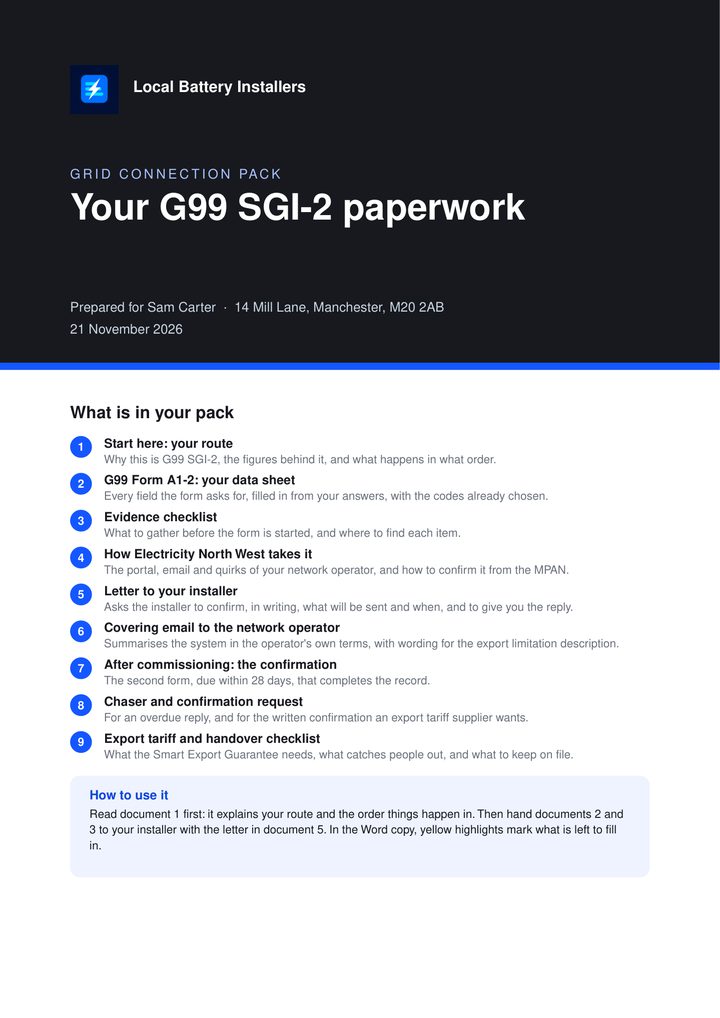
G98 and G99 paperwork
Not sure which form your system needs?
The free route finder works out whether your solar or battery is G98, or G99 SGI-1, SGI-2 or SGI-3, from the inverter sizes. The £19 pack then fills in the form data, the evidence checklist and the letters for your network operator.
Frequently asked questions
Do all new build homes in England have to have solar panels?
From 24 March 2027, new homes in England must have on-site renewable electricity generation under requirement L3, and the government expects this to be solar panels in most cases. Homes registered with building control before that date and started before 24 March 2028 can still be built to the earlier rules.
Has the Future Homes Standard been published?
Yes. GOV.UK published the regulations, Building Circular 01/2026 and Approved Document L 2026 on 24 March 2026, under the name Future Homes and Buildings Standards. Revised versions of both volumes, and an FAQ page, were added on 8 September 2026. We checked these pages on 25 November 2026.
Do I need the MCS certificate to get export payments?
Ofgem's SEG guidance says that for solar systems up to 50 kW, SEG licensees will ask you to show the installation and installer are suitably certified, usually with an MCS certificate or equivalent. Ask the developer for it before completion, as MCS will not raise a new certificate if the installer cannot provide one.
Does the new standard require a home battery?
No. The circular creates a requirement for renewable electricity generation, not storage. You can add a battery later, either with its own inverter or through a hybrid inverter if one was fitted, and it will need DNO notification.
Want a real price for your home?
Figures here are a guide. An installer still needs to see your fuse board, where the battery will go and whether you want backup. Tell us your postcode and local installers will quote.
Related guides


Sources
- GOV.UK: The Future Homes and Buildings Standards, Building Circular 01/2026
- GOV.UK: Approved Document L 2026
- GOV.UK: Approved Document L frequently asked questions
- GOV.UK: Rooftop solar for new builds to save people money (June 2025)
- Welsh Government: The Building etc. (Amendment) (Wales) Regulations 2026
- Ofgem: Smart Export Guarantee, generators
- Ofgem: SEG guidance for generators
- MCS: Notifying DNOs
- MCS: Certificate queries
- MCS: Solar panels
- MCS: Battery storage
- MCS: MIS 3012 Battery Installation Standard